
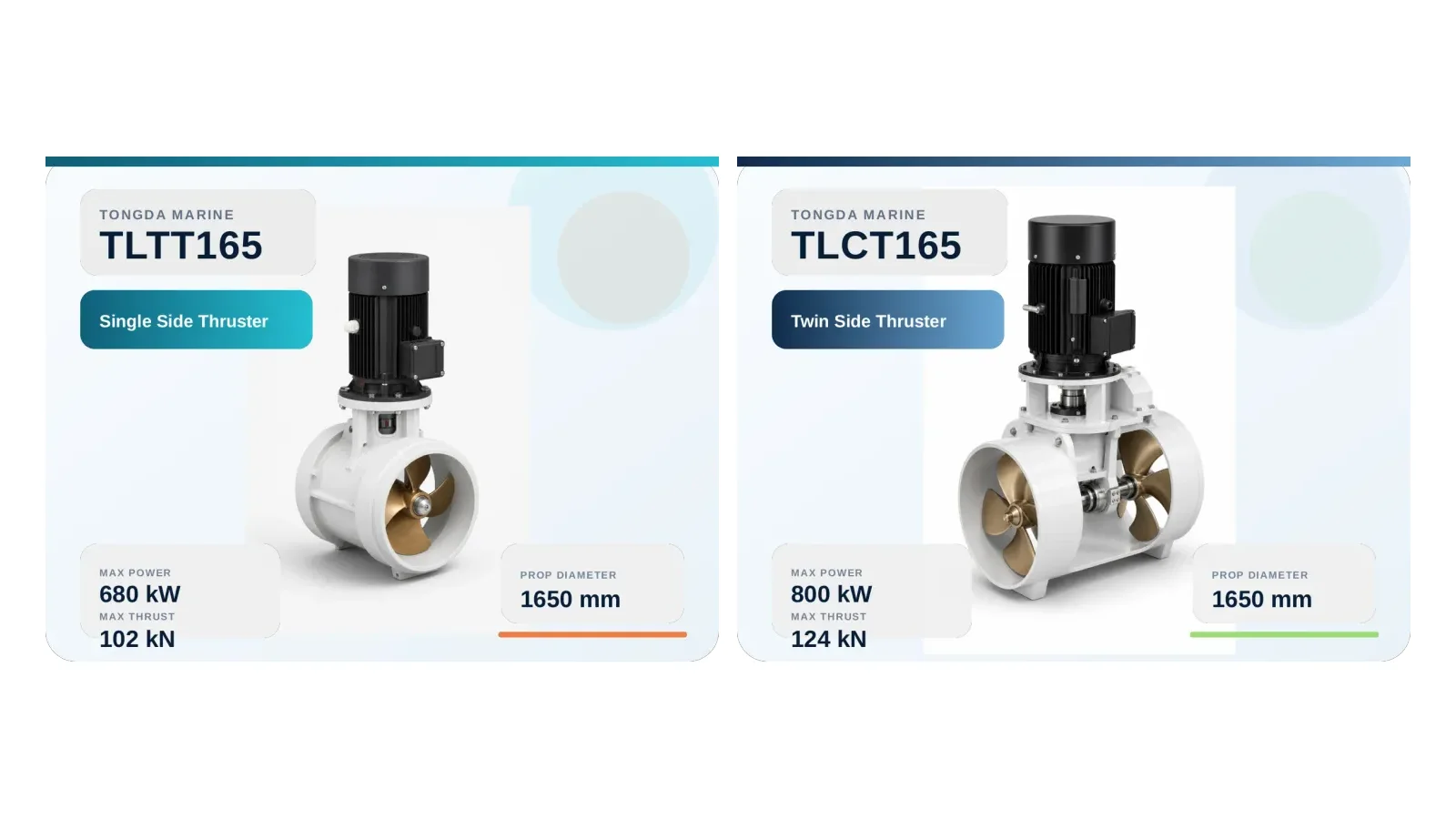
A tunnel side thruster is a propeller mounted inside a transverse tube through the hull, near the bow or stern. When it turns, it pushes water out of one side of the ship and moves the bow or stern sideways without any forward speed. That is what lets a ferry, tug, offshore supply vessel or workboat berth without a tug, hold position against wind and current and turn in a crowded harbour. Sea Keepers supplies two tunnel thruster ranges: single-propeller TLTT units and twin-propeller TLCT units. This guide explains how they are rated and how to size one.
How each unit is rated
Every catalogue entry gives the same figures: maximum input power, propeller diameter, tunnel inner diameter, tunnel wall thickness, tunnel length and maximum thrust, plus the drive options. Thrust is the number that decides whether the vessel can be moved; power tells you what the drive must supply; the tunnel diameter and length tell the shipyard how much of the hull must be cut and how much width the unit needs. All units can be driven by a diesel engine, an electric motor or a hydraulic motor.
Single-propeller TLTT range
The TLTT range covers larger vessels. TLTT110 has an 1100 mm propeller in a 1130 mm tunnel, takes up to 330 kW and delivers 49.5 kN. The range then steps up through TLTT130 (470 kW, 70.5 kN), TLTT150 (560 kW, 84 kN), TLTT165 (680 kW, 102 kN), TLTT180 (880 kW, 132 kN) and TLTT200 (1020 kW, 147.9 kN). The larger units are TLTT220 (1300 kW, 188.5 kN), TLTT240 (1600 kW, 232 kN), TLTT265 (1950 kW, 282 kN), TLTT280 (2200 kW, 319 kN), TLTT300 (2800 kW, 406 kN) and TLTT330, with a 3300 mm propeller, 3150 kW and 456 kN for the largest offshore and passenger ships.
Twin-propeller TLCT range
The TLCT units carry two propellers on a common shaft line inside the tunnel, which delivers more thrust for a given tunnel diameter. The range starts very small: TLCT25 has a 250 mm propeller, 18.5 kW and 2.8 kN, and TLCT37 offers 37 kW and 5.9 kN, which suits yachts, small ferries and workboats. TLCT50 (90 kW, 14.4 kN), TLCT70 (185 kW, 29.6 kN), TLCT80 (280 kW, 44.8 kN) and TLCT100 (355 kW, 56.8 kN) cover tugs, pilot boats, fishing vessels and coastal cargo ships. TLCT120 (550 kW, 88 kN), TLCT145 (650 kW, 100 kN), TLCT165 (800 kW, 124 kN), TLCT180 (1200 kW, 186 kN) and TLCT200 (1500 kW, 232 kN) serve larger ships where the hull depth limits the tunnel size.
Single or twin propeller
Compare the two ranges at the same tunnel size. A TLTT165 and a TLCT165 both use a 1650 mm propeller, but the twin unit gives 124 kN against 102 kN, with a longer tunnel of 2100 mm against 1400 mm. Choose the twin-propeller unit when the draught or the hull shape at the bow limits the tunnel diameter but you still need more thrust. Choose the single-propeller unit when there is room for a larger tunnel, because it is shorter, simpler and suits narrower hulls.
Sizing the thrust
Thrust must overcome the side force of wind on the hull and superstructure, current on the underwater body and the inertia of the ship. A ship with high sides, a large superstructure or deck cargo, such as a ferry, a car carrier or an offshore vessel, needs much more thrust than a low tanker of the same length. Calculate the wind area of the side profile and the lateral underwater area, decide the wind speed in which the ship must still berth, and size the thruster with margin. Where one large tunnel is not possible, two smaller tunnels at the bow, or a bow and stern pair, are common. Sea Keepers' naval architects can carry out this calculation as part of the order.
Choosing the drive
An electric motor is the most common drive on ships with enough generator capacity, because it is easy to control from the bridge and needs little maintenance. A hydraulic motor suits smaller vessels that already have a hydraulic power pack for cranes or winches. A dedicated diesel engine is used when the ship's electrical plant cannot support the thruster load. Check the generator capacity and the starting current early, because a large electric thruster can be the biggest single load on board.
Installation points the yard must get right
The tunnel must sit as low and as far forward as the hull allows, with enough immersion above it that the propeller does not draw air in a light or trimmed condition. Tunnel openings should be rounded or faired to reduce resistance and noise, and grids may be fitted to protect the propeller. The tunnel plate thickness is given in the catalogue and must be welded and stiffened into the hull structure to class approval. Plan access for the drive and maintenance, and confirm the class society, the shaft seals and the cathodic protection before the hull is cut.
What to include in an enquiry
Give the vessel type, length, beam, draught, displacement and side wind area, the required thrust or the berthing wind limit, the space available for the tunnel at the bow or stern, the preferred drive with available power and voltage, the control system and bridge stations, the classification society, quantity, and the delivery port. With that information Sea Keepers can confirm the TLTT or TLCT model, the drive and the installation package.
For the business buyer
Confirm the intended vessel or facility, operating environment, quantity and required approval before requesting a quotation. Capacity, coverage and service interval should be matched to the risk rather than selected by headline price.
For technical experts
Verify the delivered model against the maker reference, rating, dimensions, materials, operating limits and certification scope. Record the serial or batch number and retain the manufacturer datasheet, declaration, test report and maintenance instructions in the vessel file.
Product comparison
Compare alternatives on certified performance, compatibility, installation requirements, inspection interval, spares availability and total life-cycle cost. A lower unit price is not a like-for-like comparison when approval documents or service support differ.
Request a tunnel thruster quotationWant the full specification pack or a delivery quotation?
Enquire about the ferry