
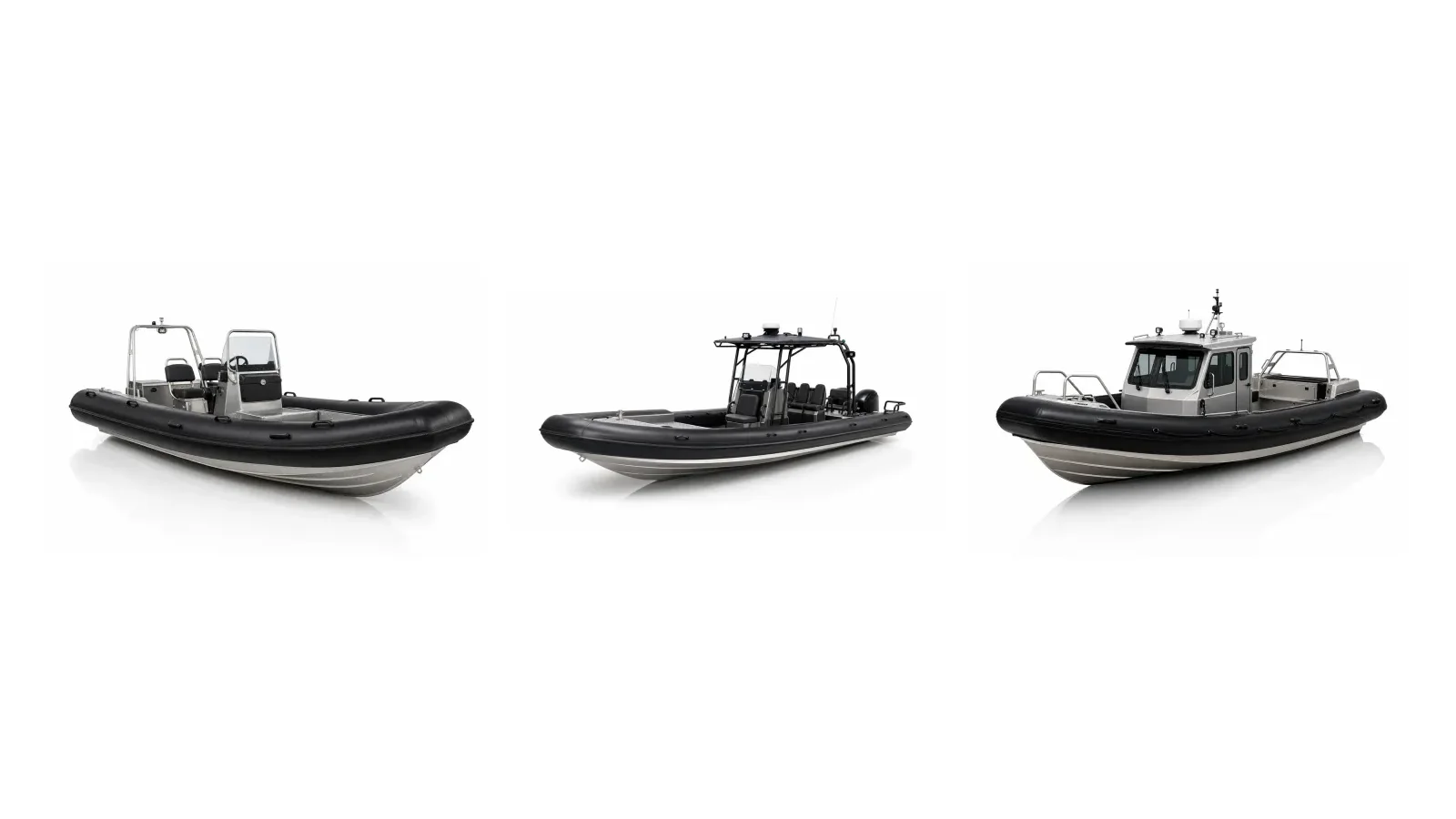
A rigid inflatable boat combines a solid hull with an inflatable collar. The hull gives the boat its running shape and strength; the tube gives reserve buoyancy, roll stability and a soft fender for coming alongside ships, quays and people in the water. Sea Keepers supplies SKPL aluminium RIBs in six size classes, from small harbour tenders to long-range offshore rescue craft. This guide explains how the classes differ, what the hull and tube choices mean and how to specify a boat that suits the job.
Why an aluminium hull
Every SKPL RIB is built on a 5052 or 5083 marine-grade aluminium hull. Both alloys resist seawater corrosion without paint, can be welded and repaired in most shipyards, and tolerate beaching, ramp launching and knocks against steel hulls far better than a thin glass-fibre bottom. An aluminium hull is also lighter than steel and does not absorb water over time, which keeps the boat's weight and trim stable through its service life. For operators who tow, crane or davit-launch their boats, that weight saving makes handling and lifting gear simpler.
Hypalon or PVC tubes
The collar is offered in Hypalon or PVC. Hypalon-based fabric is the usual choice for boats that live outdoors in strong sun and heat, work every day and are expected to last many seasons, because it resists UV, abrasion, fuel and oil. PVC is lighter and lower in cost and suits boats that are stored under cover, used seasonally or replaced on a shorter cycle. For patrol, rescue and offshore work in hot climates such as the Gulf and the Arabian Sea, Hypalon is normally the safer specification.
The six size classes
The 3-4 m class (SKPL-B001) is a compact tender with bench seating for marina support, yacht tender duty and transfers in protected water. The 4-5.5 m class (SKPL-B002) is an open utility boat with storage benches, used for crew transfer, light rescue, harbour patrol and fishing support. The 5.5-6.5 m class (SKPL-B003) adds a centre console with console or jockey seating for coastal patrol, survey work and fast personnel movement.
The 6.5-8 m class (SKPL-B004) brings a T-top, console, aft bench and patrol seating for patrol, rescue response, inspection and commercial operations. The 8-10 m class (SKPL-B005) is a cabin RIB with wheelhouse seating and an aft working deck for all-weather transfers, pilot support, patrol and offshore utility. The 10-12 m class (SKPL-B006) is the offshore rescue boat, with multiple jockey seats and a rescue deck for offshore support, emergency response, tactical patrol and long-range work. The catalogue lists each class under several model numbers up to SKPL-B040, so state the class and length you need and Sea Keepers will confirm the matching model.
Choose by mission and sea state
Start from where the boat will work and how many people and how much equipment it must carry, not from length alone. Protected marinas and harbours suit the tender and utility classes. Open coastal water with chop and wind favours the centre-console and T-top classes, where crew sit or stand behind a console and can brace on jockey seats at speed. Work offshore, at night or in poor weather points to the cabin and offshore rescue classes, which give the crew shelter and room for electronics, survivors and stretchers. Add the weight of fuel, crew, kit and any casualties when checking that a class is large enough.
Fit-out options that matter
SKPL RIBs can be fitted with navigation lights, electric and foot bilge pumps, oars, a repair kit, lockers, a liftable table, console, T-top, boarding ladder, fuel system, trailer, cover and outboard engine. For professional boats, navigation lights, an electric bilge pump with a manual back-up, a boarding ladder and a proper fuel system should be treated as standard rather than options. A T-top adds shade and a mounting point for antennas, lights and radar; a trailer and cover matter when the boat is stored ashore between jobs.
Engine and propulsion
The open classes are normally powered by outboard engines, which keep the deck clear, are easy to service and can be lifted clear in shallow water. Size the engine to the loaded weight of the boat and the speed the mission needs, and on larger patrol and rescue boats consider twin outboards for redundancy. Sea Keepers supplies outboard motors and smart electric outboards alongside the RIB range, so hull, engine, controls and rigging can be quoted and delivered as one package.
What to include in an enquiry
State the size class or length, the intended duty, the operating area and typical sea state, the number of crew and passengers, the payload, the tube material, the fit-out items required, the engine preference or a request for an engine package, any flag, class or coastguard requirements, quantity, and the delivery port. With that information Sea Keepers can confirm the model, the engine match and the delivered price in one reply.
For the business buyer
Confirm the intended vessel or facility, operating environment, quantity and required approval before requesting a quotation. Capacity, coverage and service interval should be matched to the risk rather than selected by headline price.
For technical experts
Verify the delivered model against the maker reference, rating, dimensions, materials, operating limits and certification scope. Record the serial or batch number and retain the manufacturer datasheet, declaration, test report and maintenance instructions in the vessel file.
Product comparison
Compare alternatives on certified performance, compatibility, installation requirements, inspection interval, spares availability and total life-cycle cost. A lower unit price is not a like-for-like comparison when approval documents or service support differ.
Request an aluminium RIB quotationWant the full specification pack or a delivery quotation?
Enquire about the ferry