
A water-jet replaces the propeller, shaft, bracket and rudder with a flush hull intake, an impeller inside a duct and a steering nozzle with a reverse bucket. Nothing hangs below the hull, so the boat can run in shallow or debris-filled water, beach itself, crash-stop from full speed and work around swimmers and casualties without an exposed blade. Sea Keepers supplies the SKPL water-jet range as standalone units and inside its own water-jet vessel designs. This guide explains how the catalogue rates each unit and how to pick the right one for a hull, an engine and a job.
How a water-jet unit is rated
Every SKPL data panel carries the same six figures: an input power band in horsepower, a maximum recommended input power and input speed read from the impeller curve, the vessel displacement the unit is designed to push, the dry weight, the envelope dimensions and the control mode. The power band is the window inside which an engine can be matched; the displacement figure is the first filter when a hull is being considered; the input speed tells you whether the engine can drive the jet directly or needs a reduction. All units are built in aluminium alloy and stainless steel and are supplied as modular assemblies for bolt-in installation.
The range at a glance
SKPL099 is the smallest unit: 10-50 hp, 1.5-2.0 kg and a 372 x 114 x 114 mm envelope, intended for electric surfboards, small unmanned craft and shallow-water tenders. SKPL180 takes 30-136 hp at up to about 100 kW and 4400 rpm, weighs 27 kg and powers compact unmanned boats and amphibious pump craft. SKPL185 is the mid-compact workboat unit: 30-175 hp, 65 kg, mechanical control and a 1.5 tonne design displacement.
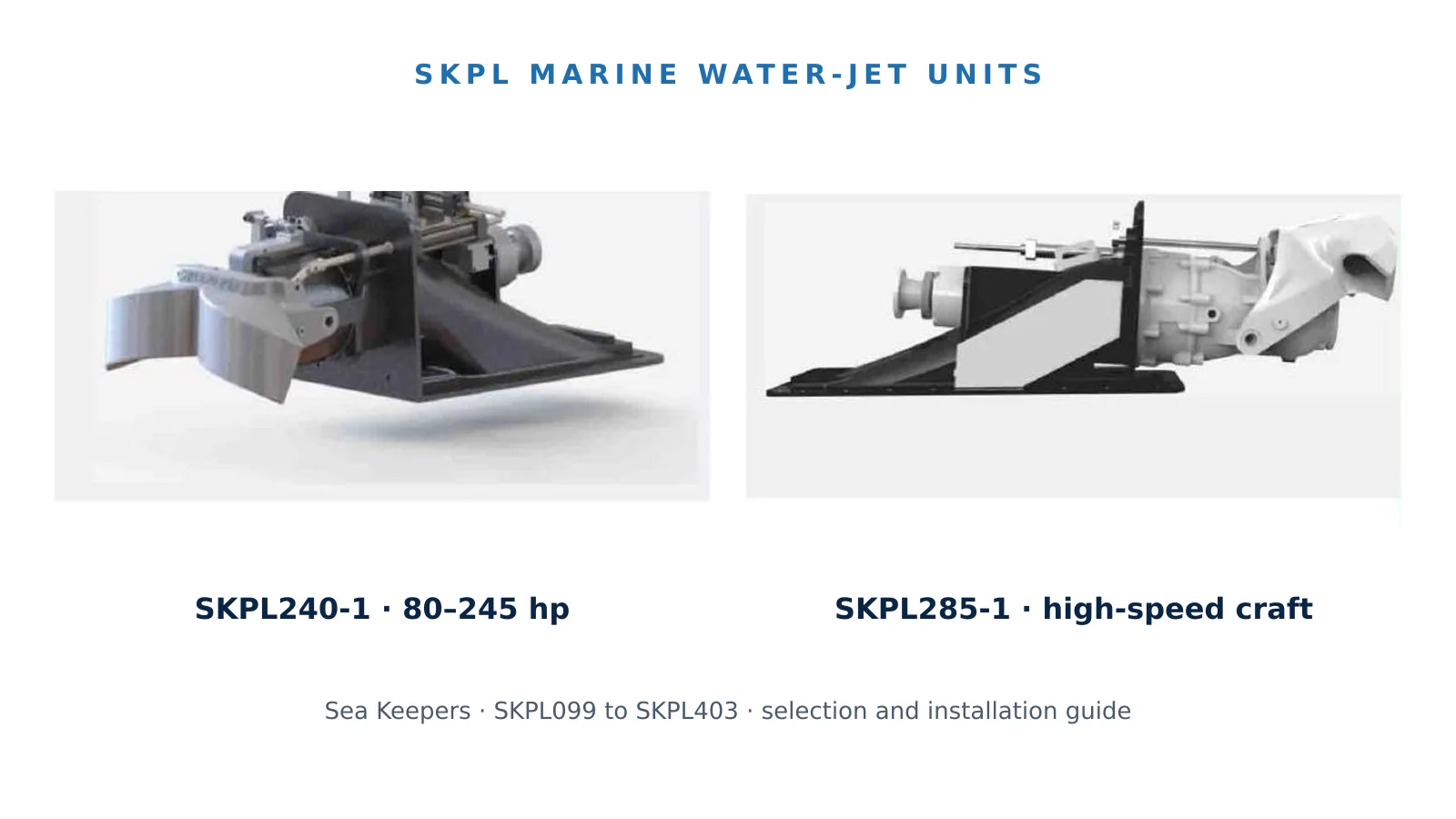
SKPL240 is the patrol and lifeboat workhorse. Each unit accepts 80-245 hp with a maximum recommended input of 200 kW at 4200 rpm, weighs 70 kg and is rated for about 2.5 tonnes as a single installation; the twin SKPL240-2 package carries fishing boats, catamarans and workboats in the 4-5 tonne class. SKPL285-1 moves up to 300-550 hp, 190 kg and 3-5 tonnes, with a maximum input of 404 kW at 3500 rpm, and the twin SKPL285-2 package serves fishery administration and patrol craft that need more thrust and tighter handling.
SKPL355-1 covers 350-814 hp at up to 600 kW and 2500 rpm, weighs 365 kg and is sized for 6-8 tonne hulls; SKPL355-2 is the twin heavy package for 8-10 tonne, 13 m class fast patrol and unmanned boats with 450-1100 hp available. SKPL403 is the largest unit in the catalogue: 550-1200 hp per jet, 650 kg, a 2743 x 700 x 833 mm envelope and a 10-12 tonne design displacement, supplied as a twin package for 15 m, 18 tonne class workboats and service vessels.
Start with displacement, not speed
The most common mistake in a jet enquiry is to start from the speed the owner wants. Start from the fully loaded displacement of the hull, including fuel, crew, stores and payload, and shortlist the units whose displacement rating covers it. Only then compare the speed each unit delivers on the catalogue applications: a 6.8 m, 1.9 tonne lifeboat on a single SKPL240 with 150 hp reaches 27 knots; a 7.5 m, 2.85 tonne coastguard boat on the same jet with 300 hp reaches 33 knots; a 12.8 m, 4.8 tonne fishing boat on twin SKPL240 with two 150 hp engines makes 25 knots. The CAV-285 landing craft shows the other end of the band, 7.6 m and 4.2 tonnes on one SKPL285 with 550 hp at 42 knots, while the 12.8 m, 9 tonne utility patrol vessel runs 28 knots on a single SKPL355 with 440 kW.
Match the engine to the impeller curve
Each data panel plots input power against input speed with a shaded impeller range. The engine's rated power and rpm must land inside that range, otherwise the impeller either cavitates at low speed or overloads the engine at full throttle. Units up to SKPL240 accept high-speed engines around 4200-4400 rpm, which suits compact marine diesels and petrol engines on direct drive. SKPL285 tops out at 3500 rpm and the SKPL355 and SKPL403 at 2300-2500 rpm, so heavier diesels normally couple through a reduction or a torsional coupling chosen for the jet's maximum input speed. Send the engine make, model, rated power, rated rpm and flywheel housing with every enquiry so the coupling and shaft line can be confirmed.
Single or twin
A single jet is lighter, cheaper and simpler to install, and the SKPL240 and SKPL285 singles cover most patrol boats, lifeboats, landing craft and transport boats up to about 5 tonnes. Twin packages are chosen when the displacement exceeds the single-unit rating, when the hull is wide enough that a centreline jet would starve one side of the intake, when the operator wants redundancy for patrol or passenger duty, or when low-speed station keeping matters. Twin jets with independent buckets can walk a boat sideways and spin it inside its own length, which is why the SKPL285-2 and SKPL355-2 packages are specified for administration and patrol vessels that board, tow and come alongside at sea.
Control mode and helm integration
SKPL185 is offered with mechanical control, which keeps the installation simple on small professional boats. SKPL240 and every unit above it use hydraulic control for the steering nozzle and reverse bucket, which lowers helm effort, allows twin units to be linked and makes a joystick or autopilot interface practical. Decide early whether the vessel will have single-lever control, a second station or integration with a dynamic positioning or autopilot system, because the hydraulic power pack, cylinders and feedback sensors are specified with the jet.
Installation points the yard must get right
The intake sits flush in the bottom of the hull ahead of the transom, so the aft buttock lines must be kept straight and clean, and the intake block must be bedded to the hull without steps or sealant ridges that would disturb the flow. The transom cut-out, the thrust bearing arrangement and the shaft alignment between engine and jet are taken from the unit's dimension drawing, and the aluminium and stainless parts need isolation from a steel hull plus sacrificial anodes in the intake area. Sea Keepers prepares the hull lines, resistance and propulsion estimate, installation drawings and weight and trim check through its naval architecture team, and supports construction through its shipyard partners.
Repowering a propeller boat with a jet
Jet conversions work best on planing or semi-planing hulls with a flat run aft and enough freeboard at the transom for the nozzle and bucket. Removing the shaft, bracket and rudder changes the trim and the aft weight, and the jet intake normally wants the hull bottom extended or faired to its block. Sea Keepers assesses conversions under its retrofitting and ship-repair service and will advise when a hull is not a good candidate rather than fit a jet that will disappoint.
What to include in an enquiry
Give the hull length, beam, fully loaded displacement and hull type, the speed target at full load, the operating area and water conditions, the intended duty such as patrol, rescue, landing, fishing or passenger service, the engine make, model, power and rpm or a request for an engine package, single or twin preference, control and station requirements, classification or flag requirements, and the delivery port. With that information Sea Keepers can confirm the SKPL unit, the coupling and the installation package in one round.
For the business buyer
Confirm the intended vessel or facility, operating environment, quantity and required approval before requesting a quotation. Capacity, coverage and service interval should be matched to the risk rather than selected by headline price.
For technical experts
Verify the delivered model against the maker reference, rating, dimensions, materials, operating limits and certification scope. Record the serial or batch number and retain the manufacturer datasheet, declaration, test report and maintenance instructions in the vessel file.
Product comparison
Compare alternatives on certified performance, compatibility, installation requirements, inspection interval, spares availability and total life-cycle cost. A lower unit price is not a like-for-like comparison when approval documents or service support differ.
Request an SKPL water-jet quotationWant the full specification pack or a delivery quotation?
Enquire about the ferry