
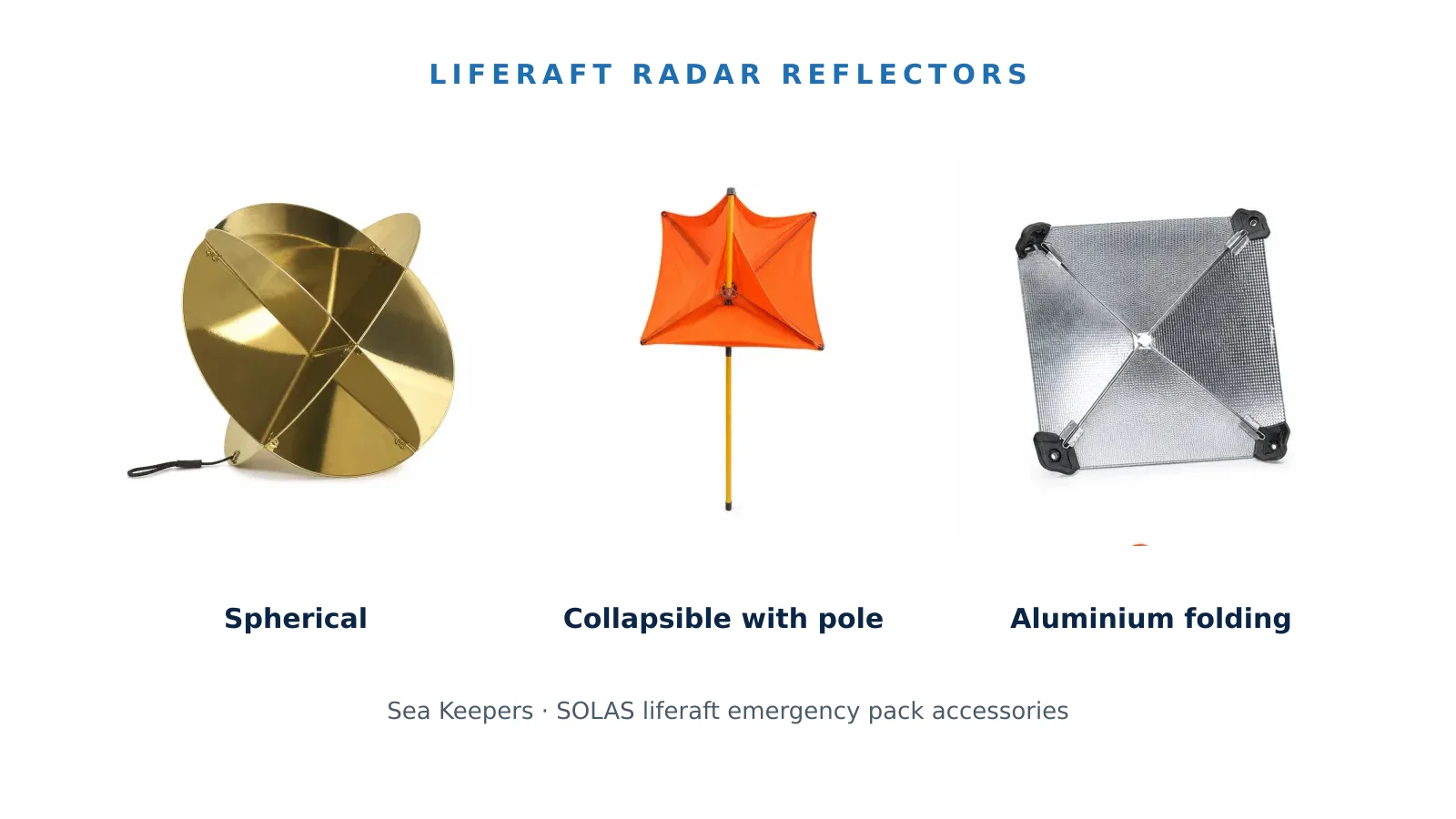
An inflatable liferaft sits low in the water, is made of fabric and gives a ship's radar almost nothing to see. The Life-Saving Appliance Code answers that with a short list of small, inexpensive items that are checked at every annual service and are the ones most often found missing or expired: a radar reflector, a daylight signalling mirror, a rescue quoit with line, a knife, paddles, sponges, bellows, a repair outfit and thermal protective aids. Sea Keepers stocks the full liferaft accessory range for service stations, owners and rescue-boat outfits, and this guide explains what each item does and how to choose between the three radar reflector designs.
What the LSA Code puts in the pack
LSA Code section 4.1.5 lists the normal equipment of every liferaft, the SOLAS A pack. Among the items are one buoyant rescue quoit attached to not less than 30 m of buoyant line, a non-folding knife with a buoyant handle stowed in an outside pocket near the painter, a buoyant bailer, two sponges, two sea anchors, two buoyant paddles, a whistle, a waterproof torch for Morse signalling, an efficient radar reflector unless a survival craft radar transponder is stowed in the raft, a daylight signalling mirror with instructions for signalling to ships and aircraft, and thermal protective aids for ten per cent of the persons the raft is permitted to carry or two, whichever is greater. Inflatable rafts must also carry a repair outfit for punctures and a topping-up pump or bellows. The reduced SOLAS B pack used on some short voyages trims provisions and pyrotechnics but keeps the reflector, mirror, quoit, knife, bailer, sponges, paddles and thermal protective aids.
Why the reflector matters
A radar reflector is a passive corner reflector: flat conductive surfaces set at right angles return a radar pulse straight back to the antenna that sent it, which turns a liferaft from a speck lost in sea clutter into a target a searching ship can track from several miles. It needs to be assembled correctly, hoisted as high as the raft allows and kept clear of the canopy's wet fabric to work. A reflector is not a substitute for an EPIRB or a search and rescue transponder, but it is the item that lets a rescue vessel without the transponder's signal find the raft on its own radar, and the Code only waives it when a SART is actually stowed in the raft.
Spherical reflector: intersecting discs
The spherical liferaft radar reflector is built from intersecting reflective metal discs that form a cluster of corner reflectors in every direction, so its return does not depend much on how the raft heels or swings. It is rigid, needs no assembly beyond hoisting and is the design most service stations fit when the container has the room. Its drawback is bulk: the sphere does not fold, so it takes a fixed slot in the raft's pack.
Collapsible reflector with pole
The collapsible liferaft radar reflector uses a diamond canopy of reflective fabric panels that opens over a support pole, so it stows flat inside the emergency pack and deploys in seconds from inside the raft. The pole raises the reflector above the canopy, which improves its effective height, and the orange canopy doubles as a visual marker. Check that the pole length and fitting suit the raft's reflector socket or lashing point, and treat the fabric as a consumable that is inspected for tears and reflective wear at each service.
Aluminium folding reflector
The aluminium folding radar reflector is a four-panel unit that opens into a corner-reflector array and folds flat for stowage. It is light, inexpensive and compact, which makes it the usual choice for rescue boats, grab bags and smaller rafts where every litre of container volume counts. Corner fittings and hinges should be checked for corrosion at service, and the panels must be fully locked open to reflect properly.
Choosing between the three
Pick by container space and duty first. A spherical unit is the simplest and most robust where it fits; the collapsible pole type gives the best height and visibility from inside an inflatable raft; the aluminium folding type suits rescue boats, davit-launched rafts with tight containers and spares stock. Service stations should match the reflector to the raft manufacturer's pack list and the certificate expected by the flag or classification surveyor, and owners replacing a lost item should confirm the raft model and capacity before ordering.
The daylight signalling mirror
The signalling mirror is the oldest item in the pack and still one of the most effective in clear weather, because a flash of sunlight can be seen by aircraft and ships well beyond the range of a hand-held light. The Sea Keepers kit is a polished mirror with a sighting hole, lanyard and protective pouch; the instructions printed with it satisfy the Code's requirement that directions for use are carried. Crews should practise aiming through the sighting hole during drills, since the technique is simple but not obvious under stress.
Keeping the rest of the pack alive
The hooded thermal protective aid and the folded reflective pack both meet the thermal protective aid requirement; the hooded full-length bag is easier to use in the raft, while the folded pack saves space when several are carried. The waterproof ID tube and the complete ID tube kit with marker, sealing disc and inventory card are how service stations keep the raft's record and instructions dry and legible. The adjustable sealing clamp is the standard answer to the Code's repair outfit for buoyancy tube punctures, the hand-operated bellows provide the topping-up pump, and the buoyant safety knife, buoyant paddles, two-piece sponge set and rescue quoit with floating line complete the list of items that are counted and dated at every inspection.
Service intervals and paperwork
SOLAS requires inflatable liferafts to be serviced at an approved station at intervals not exceeding twelve months, extendable to seventeen months only where servicing is impracticable, and the station checks, dates and replaces pack items as part of that service. Each accessory from Sea Keepers is supplied with a certificate of conformity for the survey file, and complete pack sets can be assembled to the raft maker's inventory so the station receives one consignment rather than a dozen parcels.
What to send with an order
State the raft make, model and person capacity, whether the raft carries a SOLAS A or B pack, the container type and any space limits, the reflector design preferred, the quantity of each item including thermal protective aids by raft capacity, whether certificates are needed for a specific flag or class society, and the delivery port or service station address. Sea Keepers supplies from stock in Karachi and ships to service stations and vessels across Pakistan and the Gulf.
For the business buyer
Confirm the intended vessel or facility, operating environment, quantity and required approval before requesting a quotation. Capacity, coverage and service interval should be matched to the risk rather than selected by headline price.
For technical experts
Verify the delivered model against the maker reference, rating, dimensions, materials, operating limits and certification scope. Record the serial or batch number and retain the manufacturer datasheet, declaration, test report and maintenance instructions in the vessel file.
Product comparison
Compare alternatives on certified performance, compatibility, installation requirements, inspection interval, spares availability and total life-cycle cost. A lower unit price is not a like-for-like comparison when approval documents or service support differ.
Request a liferaft accessories quotationWant the full specification pack or a delivery quotation?
Enquire about the ferry