
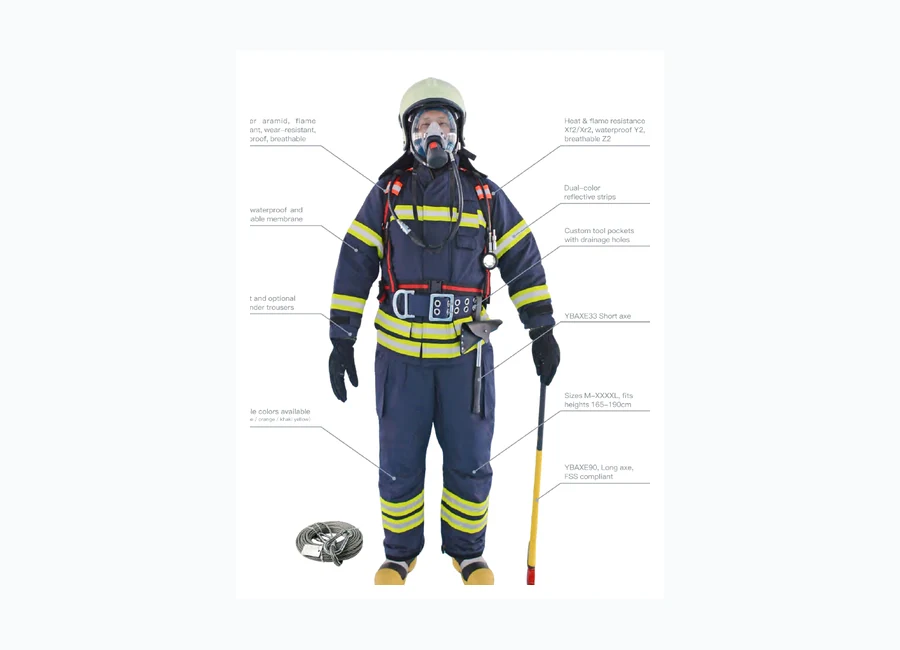
When a fire alarm sounds at sea there is no brigade to call. The people who go into the smoke are the ship's own crew, and what stands between them and the heat is the suit they pulled on at the fire locker. Sea Keepers supplies the YIBEI YBF5 firefighter protective clothing for that job: a two-piece turnout suit built to the European firefighting standard EN 469:2020 and made to be worn with the breathing apparatus, helmet, boots and axe that complete a fire-fighter's outfit.
What the YBF5 includes
The YBF5 is a split suit, a jacket with matching trousers that can be ordered with suspenders so the waist stays up under a breathing apparatus harness. The fabric is a four-layer aramid assembly: a flame-retardant, wear-resistant outer shell, a PTFE membrane that keeps water out while letting sweat vapour escape, and insulating inner layers that slow the passage of heat to the skin. Aramid fibre does not melt or drip, which is why it is the standard choice for structural firefighting clothing.
Dual-colour reflective strips run around the chest, arms, hem and legs so a team member can be picked out in smoke or on a dark deck from any side. The tool pockets are cut for the job and have drainage holes, so a hose team does not carry litres of water in its pockets after the first attack. The maker offers the suit in navy blue, orange and khaki yellow, in sizes M to XXXXL for heights from 165 to 190 cm, which lets one order cover a mixed crew.
Reading the EN 469:2020 ratings
EN 469 grades firefighter clothing on three properties, each at level 1 or level 2, and the marking on the label tells you which was achieved. X is heat protection, tested separately against flame (Xf) and radiant heat (Xr). Y is resistance to water penetration. Z is water vapour resistance, in plain terms breathability. Level 2 is the higher level in each case.
The YBF5 is rated Xf2 / Xr2, Y2 and Z2, the top level on all three. For a ship that matters in practice: level 2 heat protection is the grade intended for interior firefighting, where the team enters an enclosed space such as an engine room or an accommodation corridor; Y2 keeps hose water and steam condensate off the inner layers, since wet insulation conducts heat and scalds; and Z2 lets body heat out, because heat stress disables a firefighter in a closed steel space as surely as the fire does.
Where SOLAS expects fire-fighter's outfits
SOLAS Chapter II-2, Regulation 10.10 requires every ship to carry at least two fire-fighter's outfits complying with Chapter 3 of the FSS Code. Passenger ships carry more: two outfits and two sets of personal equipment for every 80 m of the combined length of passenger and service spaces, and ships carrying more than 36 passengers add two outfits for each main vertical zone. Tankers carry two additional outfits. The outfits must be kept ready for use in easily accessible, clearly marked positions, and where more than one outfit is carried they are stored in widely separated places so a single fire cannot reach them all.
The FSS Code defines the outfit as a set of personal equipment plus a breathing apparatus and a fireproof lifeline. The personal equipment is protective clothing of material that protects the skin from the heat radiating from the fire and from burns and scalding by steam, with a water-resistant outer surface; boots of rubber or another electrically non-conducting material; a rigid helmet; an electric safety lamp with at least three hours of burning time; and an axe with a handle insulated against high voltage. Each breathing apparatus needs two spare charges, and each fire party carries at least two portable two-way radios of an explosion-proof or intrinsically safe type.
The YBF5 fills the protective-clothing line of that list. A suit certified to EN 469 is widely accepted as meeting the FSS Code wording, but acceptance rests with the flag Administration and class, so the certificate for the suit should travel with the quotation and be checked against your flag's requirements before the order is placed.
Building the complete outfit
A suit on its own is not an outfit, and surveyors check the locker item by item. Around the YBF5 we supply the rest of the set from the same maker: the YIBEI 6.8 F self-contained breathing apparatus for firefighting, with a 6.8 litre composite cylinder, and spare cylinders; the YBAXE90 long axe, which meets the FSS Code requirement, and the YBAXE33 short axe for the belt; and fireproof lifelines in 30, 40 and 50 m lengths with snap hooks. Helmets, boots, gloves and safety lamps are quoted with the suit so that the whole outfit arrives as one consignment with one set of certificates.
Fit, colour and ordering
Turnout gear only protects when it fits. A jacket that is too short opens a gap at the waist when the wearer bends or crawls; trousers that are too long catch on ladder rungs. Take height and chest measurements for the named members of the fire party rather than ordering a standard size for everyone, and hold at least one spare suit in the most common size. The suit is worn over normal working clothes and under the breathing apparatus harness, so try it on with the harness fitted before accepting delivery.
Colour is more than appearance. Many operators issue one colour to the fire party and another to the team leader so the officer in charge can be identified from behind in smoke. Navy blue hides soot and is the usual choice for crew suits; orange and khaki yellow are easier to see on deck and in the water.
Inspection, cleaning and storage
Check each suit monthly with the rest of the outfit: seams and stitching, zips and closures, the reflective strips, the knees and elbows for wear, and the lining for tears. After any use, and after any drill with real smoke or foam, wash the suit according to the maker's label; soot and oil residues are flammable and reduce the protection of the outer shell, and chlorine bleach damages aramid fibre. Dry the suit away from direct sunlight, since ultraviolet light weakens aramid over time, and store it hanging in the fire locker rather than folded under other equipment. A suit that has been through a serious fire, or shows charring, brittle fabric or a delaminated membrane, should be replaced rather than repaired on board.
For the business buyer
Count the outfits from the fire control plan and the safety equipment certificate rather than from the last order, and add training suits so that service suits are not worn out in weekly drills. Ask for the EN 469:2020 certificate, the Declaration of Conformity and the size chart with the quotation. Order the suit, breathing apparatus, axe, lifeline, helmet, boots and lamp together where you can: a complete outfit from one supplier is simpler to certify, and the freight for one consignment is lower than for seven.
For technical experts
Check that the label on the delivered suit shows the same performance levels as the certificate (Xf2, Xr2, Y2, Z2) and record each suit's serial number, size and date of manufacture in the planned maintenance system. Confirm that the jacket and trousers overlap adequately with the breathing apparatus worn, that the collar closes over the facemask seal without lifting it, and that gloves and boots overlap the cuffs. Mark the stowage on the fire control plan, keep the two outfits in separate lockers, and include donning against the clock in the fire drill, since a suit that takes four minutes to put on is four minutes of fire growth.
Product comparison
Compare firefighter clothing on five points: the standard and the levels achieved (EN 469 level 2 versus level 1, or a suit with no firefighting standard at all), the fibre (inherently flame-resistant aramid versus treated cotton that loses protection with washing), whether a moisture barrier is fitted, the size range, and the documents supplied. Aluminised proximity suits reflect more radiant heat and still have a place for close approach to fuel fires, but they are stiff, hot and poorly suited to the ladders and doorways of interior firefighting. For the fire party that has to enter a compartment and work there, a breathable level 2 aramid suit such as the YBF5 is the more usable choice.
Request pricing for the YBF5 suit and the rest of the fire-fighter's outfit through our quote form, and tell us the vessel type, the number of outfits on your fire control plan and the sizes of the crew who will wear them so we can quote complete sets.
Request a YBF5 fire suit quotationWant the full specification pack or a delivery quotation?
Enquire about the ferry