
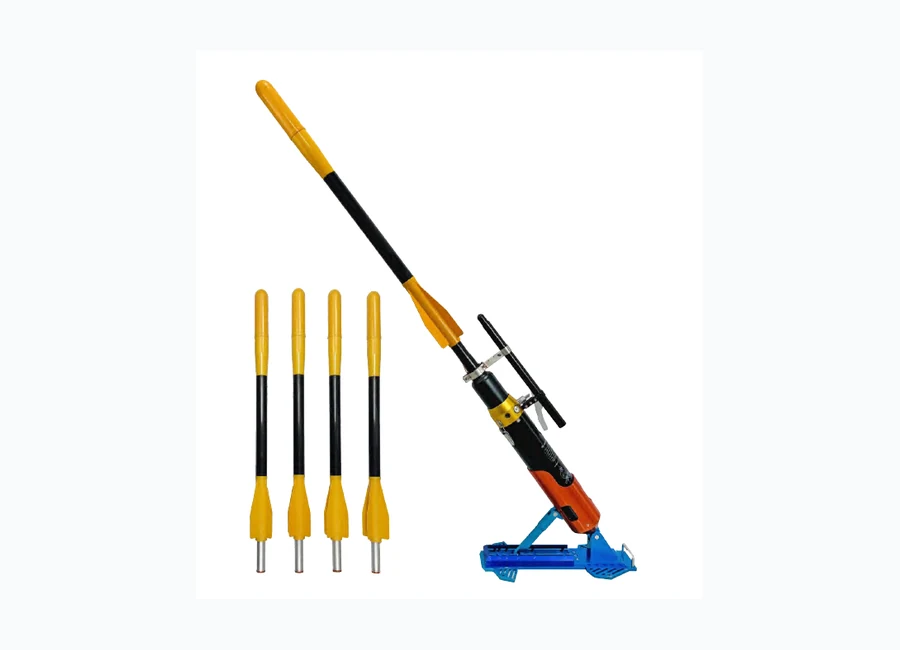
Every ship, from a harbour tug to a cruise liner, must carry a line-throwing appliance, and most of them still carry rocket units whose pyrotechnics expire every few years. Sea Keepers supplies the YIBEI YB-LT300 pneumatic line thrower as the alternative: a compressed-air launcher that throws a rescue or messenger line more than 230 metres, uses projectiles the crew can recover and fire again, and never needs a pyrotechnic replacement order.
What the YB-LT300 includes
The complete set is a shoulder-fired launcher with a folding support base, a 300 bar (30 MPa) compressed-air cylinder, a pressure regulator that brings the firing pressure down to 8.5 MPa, four orange-and-black projectiles, training projectiles, a loading device and a handling bag. The line sits coiled in a rope bag so it pays out cleanly behind the projectile, and spare rope is supplied in 150 m bags. The launcher weighs about 8 kg, light enough for one person to carry to the bow or the bridge wing and fire from the shoulder or from the base.
Because the propellant is air rather than a rocket motor, there is no flame, no smoke and no spark at the muzzle. That makes the YB-LT300 a natural choice for tankers, gas carriers, FPSOs and any vessel where a pyrotechnic launch near cargo vents needs a permit and a fire watch.
How it works on deck
The operator fits the charged cylinder to the launcher, clips the rope bag near the muzzle, slides a projectile over the barrel with the loading device and attaches the line to its tail. A pull of the trigger releases a metered charge of air; the projectile leaves the barrel, the line streams out of the bag, and the far end lands beyond the target so the receiving crew can haul the line across. Aim slightly upwind and above the target, as with a rocket, and the range beyond 230 m leaves a wide margin for crosswind and the drift of the other vessel.
After the shot the projectile is retrieved with the line, rinsed in fresh water and reused. The next shot needs only another projectile and a recharged cylinder, which the ship's own breathing-air compressor fills to 300 bar, the same pressure as the SCBA cylinders already on board.
Where SOLAS expects a line-throwing appliance
SOLAS Chapter III, Regulation 18 requires every ship to carry a line-throwing appliance complying with section 7.1 of the LSA Code. That section asks for reasonable accuracy, not less than four projectiles each able to carry the line at least 230 m in calm weather, not less than four lines with a breaking strength of at least 2 kN, and brief instructions or diagrams on the unit. The YB-LT300 is rated by the maker for more than 230 m, so a set with four projectiles and four lines meets the counts in the Code; the type-approval certificate for your flag should accompany the quotation.
Beyond the statutory rescue role, line throwers earn their keep in everyday operations: passing a messenger for a mooring or towing line to a tug, a berth or another ship; reaching a person in the water or a drifting lifeboat when the rescue boat cannot be launched; getting a line ashore after a grounding; and moving hoses or lines between a platform and a supply vessel. Port authorities, fire brigades and search-and-rescue units use the same tool from quaysides and rescue craft.
Pneumatic versus rocket line throwers
A rocket line thrower is cheap to buy and compact to stow, but each rocket is a one-shot pyrotechnic with a printed expiry, typically three years from manufacture. Expired rockets must be replaced in sets, travel as dangerous goods and need licensed disposal, so the lifetime cost of the unit sits mostly in replacements. Crews rarely practise with live rockets, and the launch produces flame and sparks.
The pneumatic YB-LT300 costs more on day one and weighs more than a rocket pistol, but the launcher and projectiles have no expiry, the only consumable is compressed air, and the crew can fire training projectiles in every drill. The trade-off is the cylinder: it must be kept charged and falls under the periodic hydrostatic test regime for pressure vessels.
Inspection, refilling and training
Monthly checks are simple: cylinder pressure in the green band, projectile fins and tails free of cracks, rope bags dry and free-running, O-rings and the regulator free of corrosion, and the instructions legible. Record the cylinder's last hydrostatic test date in the planned maintenance system. Fire a training projectile at least once a year, and after any change of deck crew, so that the person expected to use the unit in a rescue has actually held it. Sea Keepers supplies the spare parts kit, which covers the cylinder, base, projectiles, training projectiles, loading device and handling bag, and can arrange cylinder testing.
For the business buyer
Price the YB-LT300 against the rockets you would buy over the next ten years, not against a single rocket set. Ask for the approval certificate and the Declaration of Conformity with the quotation, confirm the number of projectiles and lines (four of each is the statutory minimum), and add the spare parts kit and at least two spare rope bags to the first order. Check whether your vessels already carry a breathing-air compressor; if not, agree a cylinder refilling route with the supplier or a local SCBA service station.
For technical experts
Check the cylinder's working pressure, test date and valve thread against the compressor fittings on board; a 300 bar cylinder with a standard SCBA connection avoids adapters. Verify the line breaking strength on the certificate (2 kN minimum), store the unit in a weather-protected locker near the usual firing position, and keep the stowage marked on the fire and safety plan. Log every drill shot, including which projectile was used, so wear can be tracked.
Product comparison
Compare line throwers on four points: approval scope (MED wheelmark or flag approval versus unapproved rescue tools), rated range with the line attached, consumables and their expiry, and whether the crew can train with it. Rocket units win on purchase price and stowage size. Pneumatic units such as the YB-LT300 win on lifetime cost, safety near cargo and training realism. On tankers and gas carriers the no-flame launch usually decides the question on its own.
Request pricing for the YB-LT300, the spare parts kit and extra rope bags through our quote form, and tell us how many vessels you operate and whether a breathing-air compressor is available on board so we can advise on refilling.
Request a YB-LT300 line thrower quotationWant the full specification pack or a delivery quotation?
Enquire about the ferry