
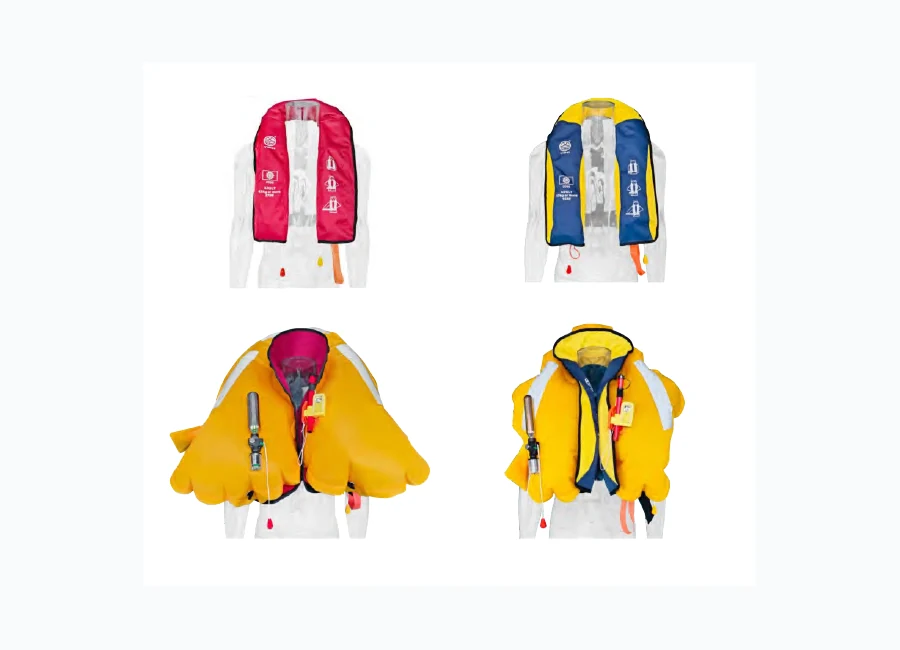
A lifejacket is the one piece of life-saving equipment issued personally to every person on board, and it is also the one most likely to be worn for hours on an open deck rather than only in an abandon-ship drill. Sea Keepers supplies the YIBEI YBA7 inflatable lifejacket family in 150 N and 275 N versions for operators who want SOLAS-approved buoyancy in a jacket slim enough to work in all day.
What the YBA7 includes
The YBA7 is a yoke-style inflatable lifejacket worn over the shoulders and secured with a waist belt and a crotch strap so it cannot ride up over the head. The outer cover opens along its seam when the chamber inflates; inside sit the buoyancy bladder, a CO2 cylinder with its inflation head, a manual pull toggle and an oral inflation tube with a non-return valve. The cover carries retro-reflective tape front and back, a whistle on a lanyard and a built-in lifejacket light, so the wearer can be seen and heard at night. The maker's fit range is adults from 43 to 140 kg, 155 cm or taller, with a chest girth up to 175 cm, which covers most seagoing crews with a single size. Children and lighter persons are issued the YBA5C foam jacket instead.
Both versions share the same construction; the difference is the size of the chamber and the gas charge. The YBA7 gives at least 150 N of buoyancy and the YBA7Pro at least 275 N, and both are specified for a buoyancy loss of no more than 5 percent, the limit the LSA Code sets after 24 hours in the water. The range is MED approved and built to SOLAS 74, and the approval certificate for the version you order should travel with the quotation.
150 N or 275 N: which rating to issue
The newton figures come from the European ISO 12402 series. 150 N (ISO 12402-3) is the general-purpose offshore lifejacket: enough lift to turn most unconscious wearers face-up in ordinary working clothes. 275 N (ISO 12402-2) is specified for extreme conditions and for people wearing heavy or air-trapping clothing such as insulated coveralls, foul-weather gear, a tool belt or an immersion suit. Air trapped in a boiler suit can hold a casualty face-down, and the extra 125 N of lift exists to overcome it.
As a working rule: 150 N for passengers, deck crews in normal clothing and inshore or harbour craft; 275 N for offshore supply, tug and workboat crews, for anyone who works in heavy weather gear, and for jackets that will be worn over an immersion suit.
How an inflatable lifejacket works
The jacket is worn deflated and weighs little more than a pair of shoulder straps. On immersion the automatic inflator fires, the cylinder discharges within seconds, the cover bursts open and the chamber fills. If the automatic head does not fire, the wearer pulls the toggle; the oral tube tops the chamber up or inflates it by mouth if the cylinder has already been used. After any inflation the jacket is rearmed with a new cylinder and a new automatic cartridge, which is why rearming kits belong on the first order.
Where SOLAS expects lifejackets
SOLAS Chapter III, Regulation 7.2 requires a lifejacket complying with section 2.2 of the LSA Code for every person on board, plus additional lifejackets at the bridge, the engine control room and any other manned watch station, and at remotely located survival craft stations. Passenger ships carry child and infant sizes and extra jackets at muster stations and on deck. The LSA Code asks every lifejacket to be donned correctly within one minute without assistance, to turn an unconscious person in the water face-up within five seconds, to carry a whistle firmly secured by a cord and a light of at least 0.75 candela for eight hours, and to be fitted with retro-reflective material.
For inflatable lifejackets the Code adds its own conditions: not less than two separate buoyancy compartments, automatic inflation on immersion, a manual inflation device and an oral inflation tube, and the full performance requirement met with either compartment lost. A SOLAS-approved inflatable such as the YBA7 is built to those rules; an unapproved sports or leisure inflatable, however well made, cannot be counted against the statutory number.
Inflatable versus foam
A foam lifejacket such as the YBA5 has no mechanism, no cylinder and no annual service: it floats on the day it is taken from the locker, which is why it remains the standard abandon-ship jacket for passengers and for the statutory count on most ships. The price is bulk and heat; nobody wears a foam jacket through an eight-hour deck watch in the Gulf, so it stays in the cabin while the crew work at the rail without it.
The inflatable YBA7 is the jacket crews actually keep on. It is compact and cool enough to wear over coveralls, and it leaves the arms free for mooring, cargo work and tender operations. In return it needs annual servicing, in-date automatic cartridges and a rearming routine, and it is not made for children. Many operators therefore keep foam jackets for the abandon-ship count and issue inflatables as working lifejackets to deck crews; whether inflatables may also be counted toward the statutory number is a question for your flag and class, and we can check it before you order. Where the abandon-ship jacket will be worn with an immersion suit, pair the suit with the YBA5/F foam jacket, which is designed for that use.
Inspection, servicing and the 12-month rule
SOLAS Chapter III, Regulation 20.8 requires every inflatable lifejacket to be serviced at intervals not exceeding 12 months, which the Administration may extend to 17 months where a 12-month service is impracticable, at an approved servicing station. On board, a monthly check covers the cover and seams, the cylinder for tightness and an unpierced seal, the cylinder weight against the figure stamped on it, the expiry date on the automatic cartridge, the oral valve and dust cap, the light and its expiry, the whistle, the reflective tape and the buckle and straps. At the annual service the bladder is inflated and held under pressure for a leak test and the cylinder and cartridge are replaced on schedule. Sea Keepers supplies cylinders, automatic cartridges and complete rearming kits and can arrange servicing through an approved station.
For the business buyer
Count the jackets from the safe-manning document and the fire and safety plan rather than from the last order: one per person, plus watch stations and remote survival craft stations, plus spares. Decide the rating by role rather than by price, 150 N for most crews and 275 N for heavy-clothing and immersion-suit work. Add rearming kits to the first order, at least one per jacket per year, and ask for the MED certificate and the Declaration of Conformity with the quotation. Hold two or three jackets back as training units so service jackets are never fired in a drill.
For technical experts
Check the certificate scope against the exact model and rating delivered, record the serial numbers and the cartridge expiry dates in the planned maintenance system, and set the 12-month service as a recurring job that falls due before the next survey. Confirm the light type and its replacement date, make sure the crotch strap is fitted and used, and store jackets dry and away from the engine-room bulkhead, since heat and damp shorten cartridge life. Train every crew member to don the jacket, pull the toggle and use the oral tube, and keep one deflated training jacket on the bridge for that purpose.
Product comparison
Compare inflatable lifejackets on six points: rated buoyancy (150 N or 275 N), approval scope (MED wheelmark or flag approval versus a leisure standard alone), the automatic inflator type and the cost and availability of its cartridges, whether the light, whistle and reflective tape are included or extra, the maker's fit range, and the servicing network for your trading area. Against foam, inflatables win on comfort and wear rate and lose on simplicity and servicing cost. For crews who must wear a jacket all day, the jacket that is worn beats the jacket that floats slightly better in the locker.
Request pricing for the YBA7 and YBA7Pro, rearming kits and lifejacket lights through our quote form, and tell us the vessel type, the number of crew by role and whether you already have access to a lifejacket servicing station so we can advise on quantities and service routes.
Request a YBA7 lifejacket quotationWant the full specification pack or a delivery quotation?
Enquire about the ferry