
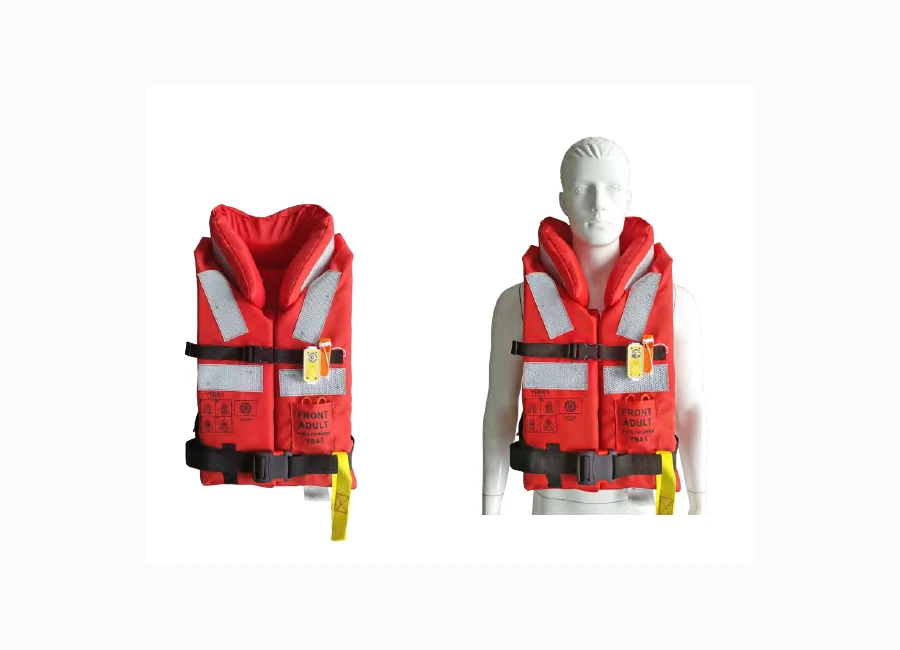
The foam lifejacket is the one piece of life-saving equipment that every person on a ship is issued personally. It has no gas cylinder to check and no bladder to inflate; its buoyancy is in the foam, available the moment it goes on. Sea Keepers supplies the YIBEI YBA5 foam lifejacket range: the adult YBA5, the YBA5C for children and the YBA5/F, a flatter cut designed to be worn together with an immersion suit. All three are built to SOLAS 74 and the IMO Life-Saving Appliance Code.
What the YBA5 family includes
Each jacket has a durable polyester outer shell over closed-cell foam. Closed-cell foam does not absorb water, so the jacket does not get heavier and lose lift the longer the wearer is in the sea. The adult YBA5 has a buoyant collar that supports the head, a front panel with two adjustable buckle straps and a crotch strap so the jacket cannot ride up over the face when the wearer jumps or is lifted. Retroreflective strips on the front, collar and back return a searchlight beam, and a survival whistle and an integrated lifejacket light are fitted as standard rather than sold separately. The jacket is marked FRONT and ADULT in large letters so it goes on the right way round in the dark, and it weighs under 0.9 kg.
The YBA5C is the child version: the same construction, sized for children of 15 to 43 kg and 100 to 155 cm in height, with a buoyancy of at least 75 N. The YBA5/F has the same 150 N buoyancy as the adult jacket in a vest shape without the deep collar, so it sits over the hood and chest of a neoprene immersion suit without lifting the face seal. It weighs under 0.9 kg and, like the others, carries reflective strips, a whistle and a light.
What the LSA Code tests a foam lifejacket for
Chapter II of the LSA Code sets the performance an adult lifejacket must demonstrate, and these are the points a surveyor looks for on the certificate. The jacket must be donned correctly within one minute without assistance after a demonstration. It must lift the mouth of an exhausted or unconscious person at least 120 mm clear of the water with the body inclined backwards, and turn an unconscious person face up in not more than five seconds. After 24 hours in fresh water its buoyancy may fall by no more than 5 per cent. It must not sustain burning or continue melting after being enveloped in fire for two seconds, and it must let the wearer jump from a height of at least 4.5 m into the water without injury and without the jacket coming off or being damaged.
The adult YBA5 at 150 N and the YBA5/F at 150 N are built to that specification; the maker describes the family as heat-resistant, impact-resistant and stable in performance, which are the fire, drop and 24-hour tests in plain words. The YBA5C at 75 N is built to the child lifejacket clause, which scales the buoyancy and the size to a child's weight range.
How many lifejackets SOLAS wants
SOLAS Chapter III, Regulation 7 requires a lifejacket for every person on board. On top of that count, ships carry enough lifejackets for the persons on watch and for use at remote survival craft stations, stowed on the bridge, in the engine control room and at any other manned watch station so that nobody has to go to a cabin to collect one. Passenger ships carry child lifejackets equal to at least 10 per cent of the passengers, or a greater number if that is needed to provide one for every child, plus infant lifejackets for the smallest passengers, and additional lifejackets for at least 5 per cent of the total persons on board stowed in conspicuous places on deck or at muster stations.
Every lifejacket must carry a light and a whistle, which is why the YBA5 ships with both fitted. Lifejackets must be readily accessible and their stowage clearly indicated, and the Code's one-minute donning time is tested in the abandon-ship drill, not just on the certificate.
Lifejacket with an immersion suit
An insulated immersion suit that meets the lifejacket performance clauses may be worn without a separate jacket, but many operators prefer to issue a lifejacket over the suit so that the drill is the same in every season and the person in the water has the lifejacket light, whistle and reflective tape at chest height where a lookout expects them. A deep-collared jacket fights with the suit's hood. The YBA5/F is the jacket for that case: a low-profile vest that straps over the YIBEI YBM3 insulated immersion suit without pushing the hood back or opening the face seal. Order the suits and the YBA5/F together and keep them stowed as a pair.
Sizing, children and stowage
Issue the YBA5C for every child by weight, not age, and the adult jacket from 43 kg upwards. On ferries and passenger vessels, keep the child jackets where they can be reached quickly rather than in a store, and mark the stowage on the muster list. Adult jackets are one size with adjustable straps, so the task is not sizing but stowage: one jacket in each cabin or berth, the watch-station jackets at their stations, and the spare and child jackets at the muster stations. Store jackets flat or hanging, dry, away from oil, paint and direct sunlight, and never with heavy stores on top of them, since crushed foam loses buoyancy.
Inspection and replacement
Check lifejackets monthly with the rest of the LSA inspection: the shell for tears and abrasion, the straps and buckles for cuts and corrosion, the crotch strap, the whistle on its lanyard, the reflective tape for peeling and the light for its expiry date. Foam lifejackets have no service interval, but they do age. A jacket with a hardened or crumbling foam core, faded reflective tape or a shell that has been washed in solvent should be replaced, and the integrated light is replaced at its expiry date whatever the condition of the jacket. Record each jacket's position and the light expiry in the planned maintenance system.
For the business buyer
Count from the safety equipment certificate and the crew list, add the watch-station jackets the regulation requires, and for passenger ships add the 10 per cent child and 5 per cent spare jackets. Order the light fitted rather than as a separate line so there is nothing to assemble on board. Ask for the MED certificate, the Declaration of Conformity and the light's expiry date with the quotation; a light that has sat in stock for two years is a light you replace early. One order for the full outfit gives one set of certificates and one freight consignment.
For technical experts
On receipt, check that each jacket's label shows the buoyancy rating, the standard and the maker, that the light and whistle are fitted and the light's expiry date is acceptable, and that the retroreflective tape is of the approved type. Run a timed donning drill with the jackets as issued, including the YBA5/F over the immersion suits for the crew who will wear them, and confirm the one-minute figure. Enter every jacket by stowage position and light expiry, and put the watch-station jackets on the bridge and engine-room inspection checklists so they are seen every month.
Product comparison
Compare foam lifejackets on the buoyancy rating and standard on the label, the foam (closed-cell foam that does not absorb water against open-cell or kapok fillings), whether the light and whistle are fitted and certified, the presence of a crotch strap and a head-supporting collar, and the cut when worn with other equipment. Inflatable lifejackets such as the YIBEI YBA7 are lighter and better for working wear, but need an annual service and a gas cylinder in date. For the jacket in the cabin, at the watch station and at the muster point, a 150 N foam jacket that works without servicing, such as the YBA5, remains the standard choice.
Request pricing for the YBA5, YBA5C and YBA5/F lifejackets through our quote form, and tell us the vessel type, the number of persons on board, the number of children carried and whether immersion suits are issued, so we can quote the right mix.
Request a YBA5 lifejacket quotationWant the full specification pack or a delivery quotation?
Enquire about the ferry