
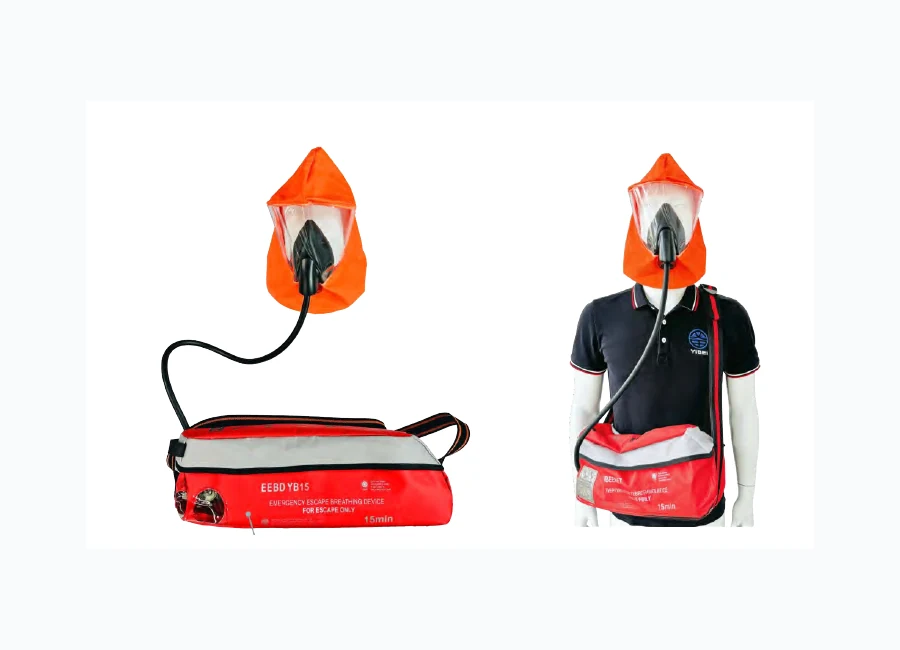
An emergency escape breathing device (EEBD) has one job: give a crew member enough clean air to get out of a smoke-filled or toxic compartment and reach a muster point. It is not a firefighting set and it must never be used to enter a space. Sea Keepers supplies the YIBEI YB15 series, the escape device most often requested alongside the SCBA sets and fireman's outfits in our fire safety catalogue.
What the YB15 hood-type EEBD includes
The standard YB15 is a hood-type device packed in a flame-retardant carry bag. Inside is a 3 L cylinder, available in steel or carbon-composite construction, a pressure reducer with an integrated valve, a removable supply hose and a hood with a clear window. The hood covers the whole head, so it goes on over glasses, beards and long hair in seconds, and the range is designed for a one-action start when the bag is opened, with no valve to find in the dark.
The rated duration is 15 minutes, comfortably above the 10-minute minimum that the IMO Fire Safety Systems (FSS) Code sets for escape devices. That margin matters on larger vessels where the route from the engine-room bottom plates to open deck passes several ladders and fire doors. Once activated the device is carried hands-free, leaving both hands for ladders and door dogs.
The manufacturer lists EN 402, ISO 23269-1, SOLAS Chapter II-2, the Marine Equipment Directive (MED) and the Pressure Equipment Directive (PED) for the cylinder. Brief donning instructions are printed on the device, as the FSS Code requires, and the label carries the serial number, shelf life and date of manufacture that surveyors ask for.
Four versions for different escape routes
YB15 hood type is the universal choice for accommodation spaces, galleys and control rooms, where anyone on board, trained or not, may need to grab a device and go.
YB15 PP is a positive-pressure version with a wide-vision full-face mask and lung-governed air supply on a 3 L composite cylinder, weighing 5 kg or less. It suits machinery spaces where the crew already trains with face masks and wants a tighter seal against smoke.
YB15PP/A is the same full-mask device with an airline connection, so it can run from a cascade or onboard compressed-air system during a longer evacuation. Its 3 L carbon-fibre cylinder holds about 900 litres of air, giving at least 15 minutes at 35 litres per minute.
YB15PP/C is the full-face-mask version with a refillable cylinder, gauge and quick-start bag opening, supplied in a high-visibility PVC bag or a black anti-static polyurethane bag for tankers and other hazardous areas.
Where SOLAS expects them
SOLAS Chapter II-2, Regulation 13 requires EEBDs that comply with the FSS Code to be stowed ready for use, in easily visible places that can be reached quickly in a fire, both in accommodation spaces and in machinery spaces. All ships carry at least two in accommodation; passenger ships carry at least two in each main vertical zone, with two more per zone when more than 36 passengers are carried. In machinery spaces the number and location follow the layout and the people normally working there, using the guidance in IMO MSC/Circ.849, and must be shown on the fire control plan. Spare devices must also be kept on board.
In practice we recommend a device at each escape route from a category A machinery space, at the engine control room, in the steering gear room and near the galley, wall boxes along accommodation corridors, and a clearly marked training unit so the crew practises donning without opening a service device.
Inspection and service life
An EEBD is only as good as its gauge reading on the day of the fire. Monthly checks should confirm that the bag seal is intact, the cylinder pressure is in the green band, the hood window is clear and the device is in its marked position. Cylinders follow the periodic hydrostatic test interval set by the pressure equipment rules, and the shelf life of the hood and valve assembly is printed on the label. Sea Keepers supplies replacement cylinders, hoods and bags and can arrange refilling and testing, so that service devices are never borrowed for drills.
For the business buyer
Count the required devices from the fire control plan rather than from the previous order, then add spares and training units. Ask for the MED certificate and the Declaration of Conformity with the quotation, and confirm whether wall brackets or boxes are included when devices go into corridors. The hood type is normally available from stock; composite-cylinder and airline versions should be ordered against the dry-dock schedule.
For technical experts
Check the delivered serial numbers against the certificate, confirm the cylinder type and its test date, and record the shelf-life date in the planned maintenance system so replacement falls due before the next survey or port state inspection. Keep hood-type devices in spaces where untrained persons may need them, and place positive-pressure full-mask sets only where the crew has drilled with them.
Product comparison
The hood-type YB15 wins on donning speed and cost per station. The PP full-face versions give a better seal and wider vision for engine-room crews, and the PP/A adds duration from a cascade system. Across all four, compare rated duration, cylinder type and weight, approval scope (MED wheelmark versus EN 402 alone), the maker's shelf life and the local availability of refill and test services. A cheaper device with no local service support costs more at the first survey.
Request pricing for the YB15 range, including spares and training units, through our quote form, and tell us the vessel type and crew numbers so we can suggest quantities by space.
Request a YB15 EEBD quotationWant the full specification pack or a delivery quotation?
Enquire about the ferry