
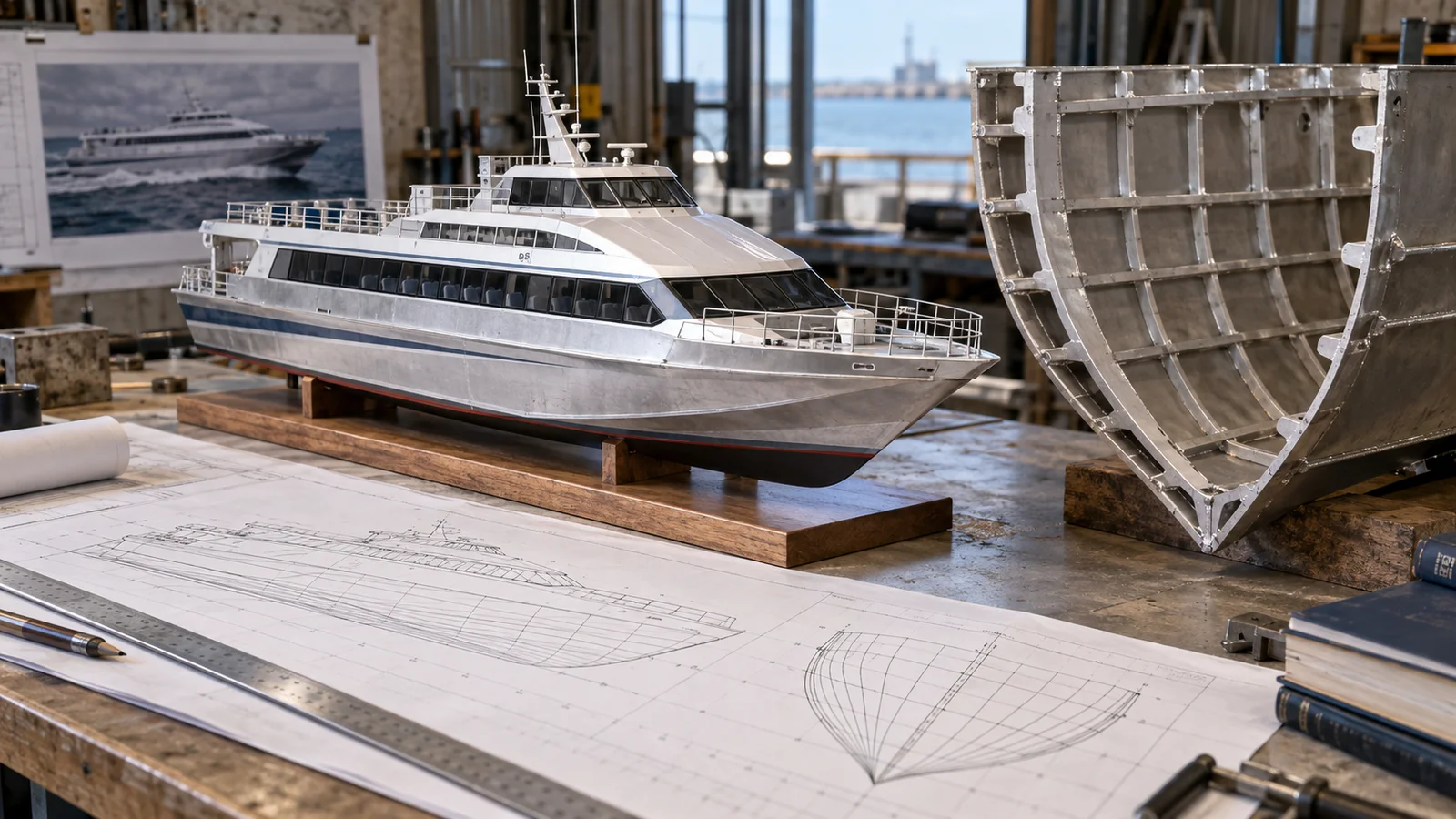
AI-generated editorial illustration.
Western Australia was one of the centres of the world’s fast-ferry boom in the late 1980s and 1990s. Yards along the coast south of Fremantle turned out hundreds of aluminium passenger vessels for operators across Asia, the Pacific, Europe and the Middle East, and a large share of them are still in service. Buyers searching for a Wavemaster ferry are looking for that pedigree: light, strong aluminium construction, sea-kindly hull forms and layouts designed around fast turnarounds.
What defines the design generation
Fast passenger monohulls of this generation share a deep-V forward section for slamming resistance, a broad, flat run aft for planing efficiency, welded marine-grade aluminium plating over closely spaced frames and stringers, and a superstructure with two enclosed passenger decks, a raised wheelhouse and open deck space forward and aft. They were built to the High Speed Craft Code or its predecessors, with evacuation and fire arrangements appropriate to open-water routes.
Why thirty-year-old aluminium hulls remain viable
Aluminium does not rust. Properly maintained, with anodes renewed and dissimilar-metal fittings insulated, an aluminium hull’s structure is largely as good at thirty years as it was at ten. What ages is machinery, wiring, windows, seating and coatings, and all of these are replaceable. A vessel that has been through a full refit, such as the 2018–2019 rebuild of the 35 m monohull Sea Keepers has for sale, effectively resets those clocks while keeping the original hull and design.
What a proper refit should include
Look for evidence of hull ultrasonic thickness measurement, renewed underwater fittings and anodes, machinery overhaul or replacement, new electrical distribution, upgraded navigation equipment, renewed seating and interior finishes, and fresh safety equipment. Ask for the refit photographs and invoices; a serious refit generates a paper trail.
Verifying provenance
Confirm the builder and design through the builder’s plate, the original general arrangement and lines drawings, and the class or statutory records. Sea Keepers provides the general arrangement and the full documentation set in the specification pack, with ownership and registry details disclosed under NDA at offer stage, as is standard in second-hand vessel sales.
Resale value
Because operators know the design generation, Australian-built aluminium fast ferries trade actively on the second-hand market in Asia, Africa and the Mediterranean. That liquidity protects a buyer: the vessel can be sold on again when a route changes or a fleet is renewed.
The 35.4 m Wavemaster-design fast ferry currently offered by Sea Keepers was built in Australia in 1995, refitted in 2018–2019, and lies in Karachi ready for inspection.
View the 35m passenger ferry for sale — full specification and photosWant the full specification pack or a delivery quotation?
Enquire about the ferry