
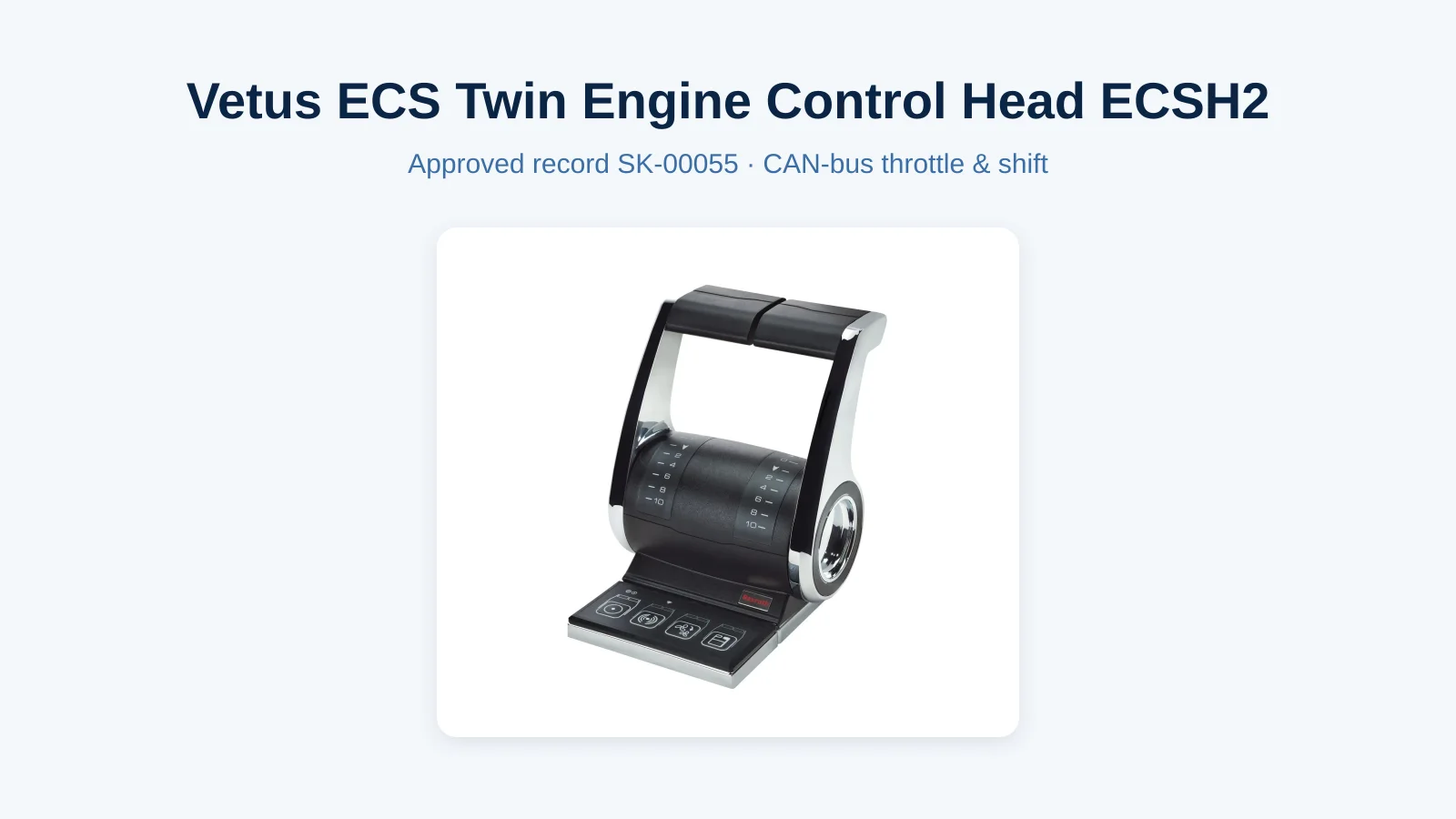
On a twin-engine boat the control head at the helm is the part the skipper touches most. Every throttle change and every shift into ahead or astern passes through it, and when it fails the boat loses manoeuvring control exactly when it is needed in a harbour or alongside. Older installations used mechanical push-pull cables from the levers to each engine and gearbox. Electronic systems such as the Vetus ECS send the same commands as signals instead, which removes cable friction and makes it possible to control the boat from more than one station. The Vetus ECS twin control head ECSH2 is now an approved record in the Sea Keepers catalogue as SK-00055. This guide explains what it is, how it fits into the system and what to check before ordering.
What the ECSH2 is
SK-00055 is the genuine Vetus ECSH2, the ECS twin control head for electronic control of two engines. It is the helm lever unit that sends throttle and shift commands over CAN-bus to the engine and gearbox actuators. The record carries the code 02.08.0228, which is the supplier's own item number for the Vetus ECSH2 rather than a Vetus part number, so a quotation or a purchase order may show either reference. Vetus states that the ECS was developed with Rexroth as the successor to the earlier Vetus RECO controls. No supersession was found in the sources reviewed.
How the ECS system works
In an ECS installation the control head does not move the engines directly. Each lever position is converted into a signal and sent over the CAN-bus network to an actuator at each engine and gearbox, which moves the throttle and the shift lever. Because the link is a data cable rather than a push-pull cable, the system supports single or twin engines from up to four control stations, for example a main helm, a flybridge and wing stations. The ECS range also offers optional trolling control, auto-diagnostics with an alarm log, backlit illumination for night use and a backup Hall sensor in the lever, uses Bosch components and is ABYC compliant.
When a control head is replaced
A control head is normally replaced when a lever no longer gives a smooth, repeatable signal, when the alarm log shows sensor faults that follow the head rather than the cabling or actuators, when water has entered the unit at an exposed station, or when the boat is being converted from mechanical cables to electronic control. Before a head is condemned, the CAN-bus cabling, connectors, power supply and the actuators should be checked, because a corroded plug or a failing actuator can produce the same symptoms. The ECSH2 is the twin version: a single-engine boat uses a single-lever head, and the two are not interchangeable.
Where the ECSH2 fits on a vessel
The ECSH2 is used on twin-engine leisure craft and small work boats fitted with the Vetus ECS system. On boats of this size it sits alongside the other helm and propulsion equipment that Sea Keepers supplies, such as tunnel bow and stern thrusters for close-quarters handling, outboard motors and their rigging, and electric propulsion systems for hybrid conversions. For an aluminium RIB or patrol boat being fitted out with twin engines, the control system is chosen at the same time as the engines, the steering and the thrusters, so that the helm layout and the cable runs are planned once.
Installation and set-up notes
The control head is mounted at the helm with clearance for full lever travel in both directions, and its connector and cable entry are kept out of standing water. The CAN-bus network is laid out as the Vetus installation manual specifies, with the correct terminations at each end, and each actuator is set up for the throttle travel and the gearbox shift positions of its engine. After installation the system is calibrated, the neutral position and shift points are checked at every station, and the station-transfer function is tested before the boat is handed over. On a retrofit from mechanical cables, the existing throttle and shift linkages at each engine are inspected before the actuators are connected.
What to send with an enquiry
To confirm the correct control head, send the boat type and length, the make and model of both engines and gearboxes, whether the boat already has a Vetus ECS system or is being converted from cables, the number of control stations, whether trolling control is required, and photographs of the existing head and its label. Sea Keepers will confirm the Vetus reference, advise which actuators, cables and panels are needed and quote delivery to the vessel or yard.
For the business buyer
Confirm the intended vessel or facility, operating environment, quantity and required approval before requesting a quotation. Capacity, coverage and service interval should be matched to the risk rather than selected by headline price.
For technical experts
Verify the delivered model against the maker reference, rating, dimensions, materials, operating limits and certification scope. Record the serial or batch number and retain the manufacturer datasheet, declaration, test report and maintenance instructions in the vessel file.
Product comparison
Compare alternatives on certified performance, compatibility, installation requirements, inspection interval, spares availability and total life-cycle cost. A lower unit price is not a like-for-like comparison when approval documents or service support differ.
Request a Vetus ECS control quotationWant the full specification pack or a delivery quotation?
Enquire about the ferry