
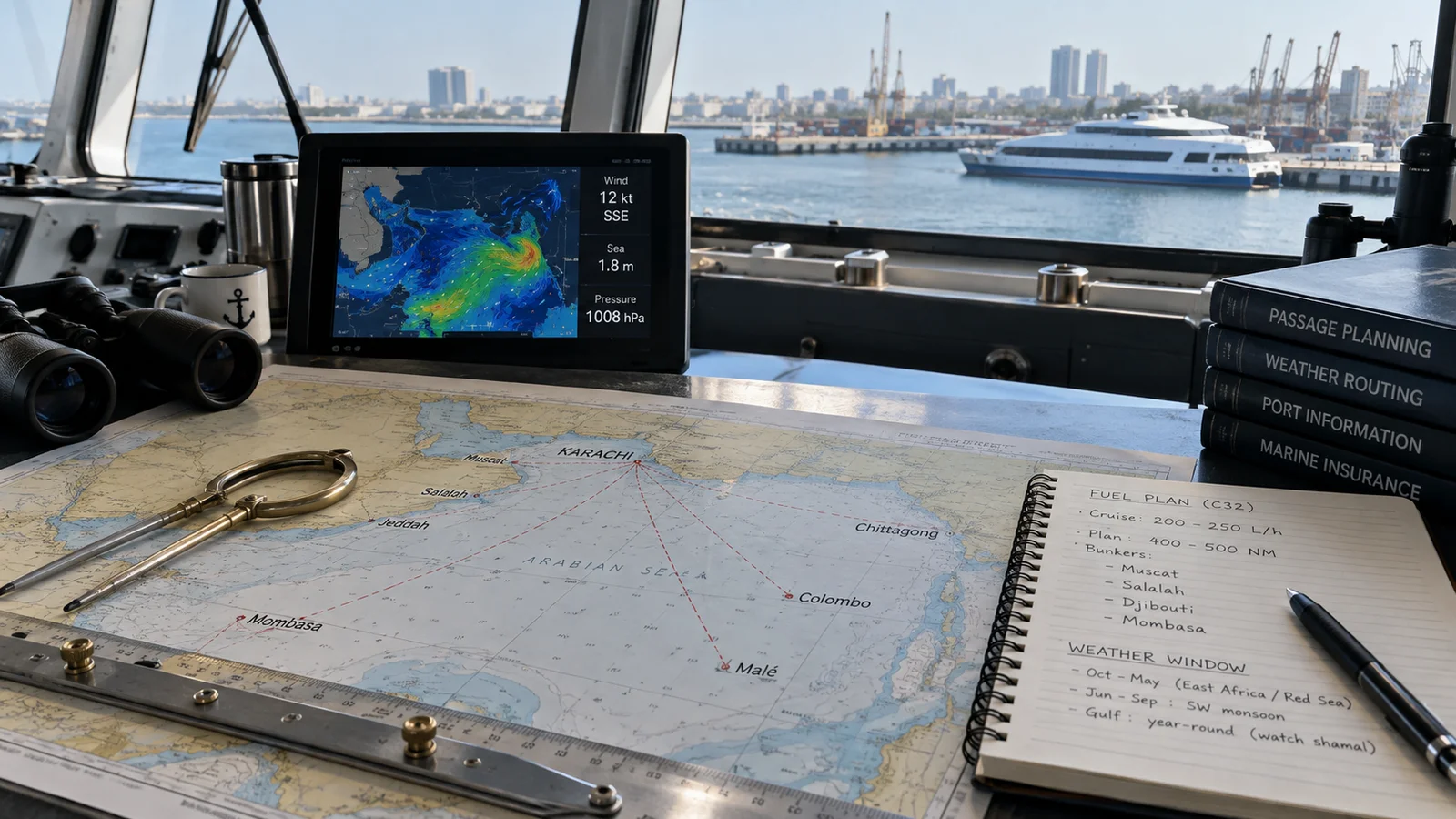
AI-generated editorial illustration.
One of the first questions a buyer asks about a vessel lying in Karachi is how it gets to their port and what that costs. For a 35 m fast ferry the answer is usually an own-keel delivery voyage within the region, or heavy-lift shipment for the longer passages. This article gives approximate distances, the main cost lines and the planning points that make the difference between a smooth delivery and a delayed one.
Approximate distances from Karachi
Muscat is about 450 nautical miles; Dubai and Abu Dhabi around 700; Doha, Manama and Kuwait between 900 and 1,100. Colombo is roughly 1,450 nautical miles and Malé about 1,500. Jeddah on the Red Sea is around 2,100 via the Gulf of Aden, Dar es Salaam about 2,400 and Mombasa slightly less. Chittagong is roughly 2,650 around the tip of India, and Piraeus about 3,600 through the Suez Canal. These figures are for planning only; the delivery captain's passage plan will set the final route.
Own-keel delivery voyage
For destinations up to about 2,500 nautical miles an own-keel voyage is normally the most economical option. Sea Keepers supplies a professional delivery crew, prepares the passage plan and bunkering schedule, and arranges port clearances and delivery insurance. With 9,800 litres of fuel on board and a Caterpillar C32 burning in the region of 200–250 litres per hour at cruising load, legs should be planned conservatively at around 400–500 nautical miles between bunkering stops, running at an economical speed rather than the 28-knot design speed. Muscat, Salalah, Djibouti and Mombasa are the usual stops on the East Africa run; Fujairah and Muscat serve the Gulf.
Heavy-lift and semi-submersible shipment
For the Mediterranean, West Africa, the Caribbean, Latin America or the Pacific, shipping the ferry as deck cargo on a heavy-lift or semi-submersible vessel avoids thousands of miles of engine hours and weather risk. The vessel is lifted or floated on at Karachi, cradled and sea-fastened, and delivered on a fixed schedule. Sea Keepers' naval architects prepare the lifting and sea-fastening drawings, which the carrier requires before booking.
Weather windows
The Arabian Sea has a strong south-west monsoon from June to September, when open-water passages towards East Africa and the Red Sea are uncomfortable for a fast craft and some ports restrict small-vessel movements. The best delivery window for East Africa and the Red Sea is October to May; Gulf deliveries are possible year-round with attention to shamal winds in winter. Plan the purchase timetable around these windows rather than trying to sail into them.
Paperwork and insurance
A delivery voyage needs a provisional registration or delivery flag, a minimum safe-manning document, delivery insurance covering hull and P&I, port clearance from Karachi and, for Suez, canal tonnage certificates and agency. Reflagging before departure is often simplest, because the vessel then arrives already under the buyer's administration. Sea Keepers handles the documentation with the buyer's registry and the Karachi port authorities.
Getting a delivery quotation
Ask for a delivery quotation to your port at the same time as the specification pack. A firm figure for crew, bunkers, insurance, port dues and canal transit lets you compare the landed cost of the ferry against alternatives lying closer to home — and in most cases the combination of a competitive Karachi price and a short regional voyage comes out ahead.
Sea Keepers' 35 m aluminium monohull fast ferry — 220 persons, Caterpillar C32, refitted 2018–2019 — is lying afloat in Karachi and available for inspection, with own-keel or heavy-lift delivery arranged in-house.
View the full listing, specification and photo galleryWant the full specification pack or a delivery quotation?
Enquire about the ferry