
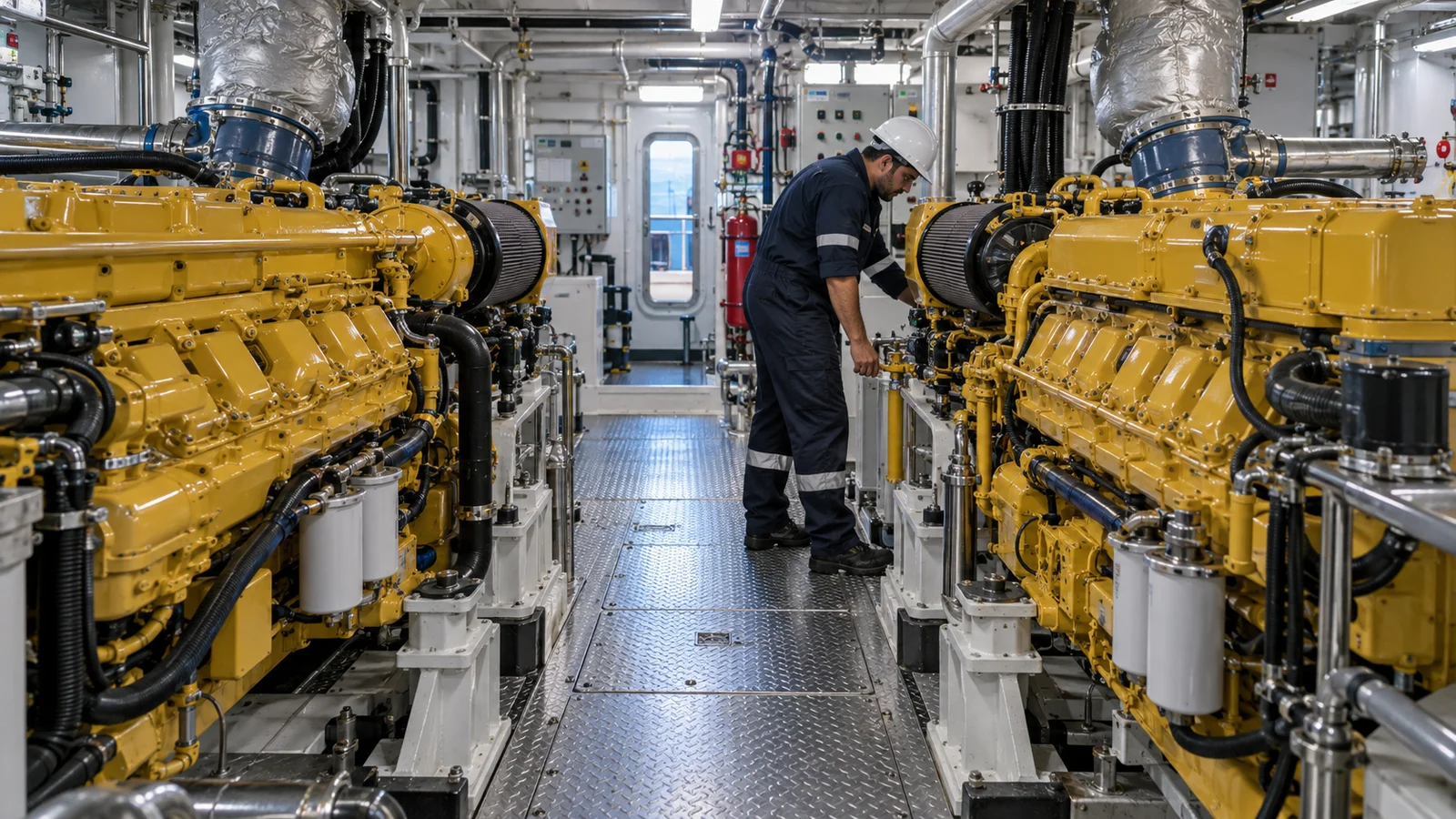
AI-generated editorial illustration.
When operators search for a Caterpillar C32 ferry for sale they are really searching for peace of mind. The C32 is a 32-litre V12 marine diesel that has powered fast ferries, crew boats, patrol craft and yachts for two decades, and it is supported by one of the widest dealer networks in the marine industry. This article explains what the engine tells you about a used fast ferry and what to check before you buy.
Why the engine choice matters more than the badge
On a second-hand high speed craft the propulsion package decides three things: how much it costs to run, how quickly it can be repaired when something fails, and how easy the vessel is to resell. A common, well-supported engine family scores on all three. In East Africa, the Gulf, South Asia and the Mediterranean, Cat dealers and independent specialists stock parts and can put a technician aboard within days, which is not always true for less common engines or waterjet packages.
The installation on the Sea Keepers listing
The 35 m aluminium monohull currently for sale is powered by a Caterpillar C32 marine diesel rated at 1,044.5 kW (about 1,400 hp), driving a five-blade fixed-pitch propeller of 1,150 mm diameter through a marine gearbox, for a design speed of 28.3 knots at 75% load. Hotel load is carried by a Perkins P50 generator of 50 kVA. Fixed-pitch propeller drive is deliberately simple: no jet impellers, no steering nozzles, and standard shaft-seal and bearing maintenance that any yard can perform.
What to check on a used C32
Ask for total hours and hours since the last top-end or major overhaul, and for the service history with part numbers. Request oil-analysis results, check turbocharger condition, aftercooler and heat-exchanger cleanliness, exhaust manifold and raw-water pump condition, and look for coolant or fuel leaks around the injectors and lines. On sea trial, record boost, exhaust temperature and coolant temperature at 50%, 75% and full load and compare them with the Cat performance sheet. Engine hours, service records and the latest survey are available on request for the Sea Keepers vessel.
Estimating fuel burn for your route
As a planning figure, a modern high speed diesel burns in the region of 200–210 grams of fuel per kilowatt-hour at cruise. At 75% load on a 1,044.5 kW engine that is roughly 180–200 litres per hour, to be confirmed on the vessel’s own sea trial. On a 40-nautical-mile crossing at 28 knots, budget about 300 litres each way including manoeuvring, and set your fare and timetable accordingly.
Parts, training and resale
Because the C32 is so widely used, spare parts, filters and consumables are stocked regionally, and engineers trained on the Cat electronic control system are easy to find. This matters when you come to sell the vessel on: buyers pay more for tonnage they know they can maintain.
The Caterpillar C32 ferry Sea Keepers is offering lies afloat in Karachi and can be sea-trialled with your surveyor. Request the specification pack for full machinery particulars.
View the 35m passenger ferry for sale — full specification and photosWant the full specification pack or a delivery quotation?
Enquire about the ferry