
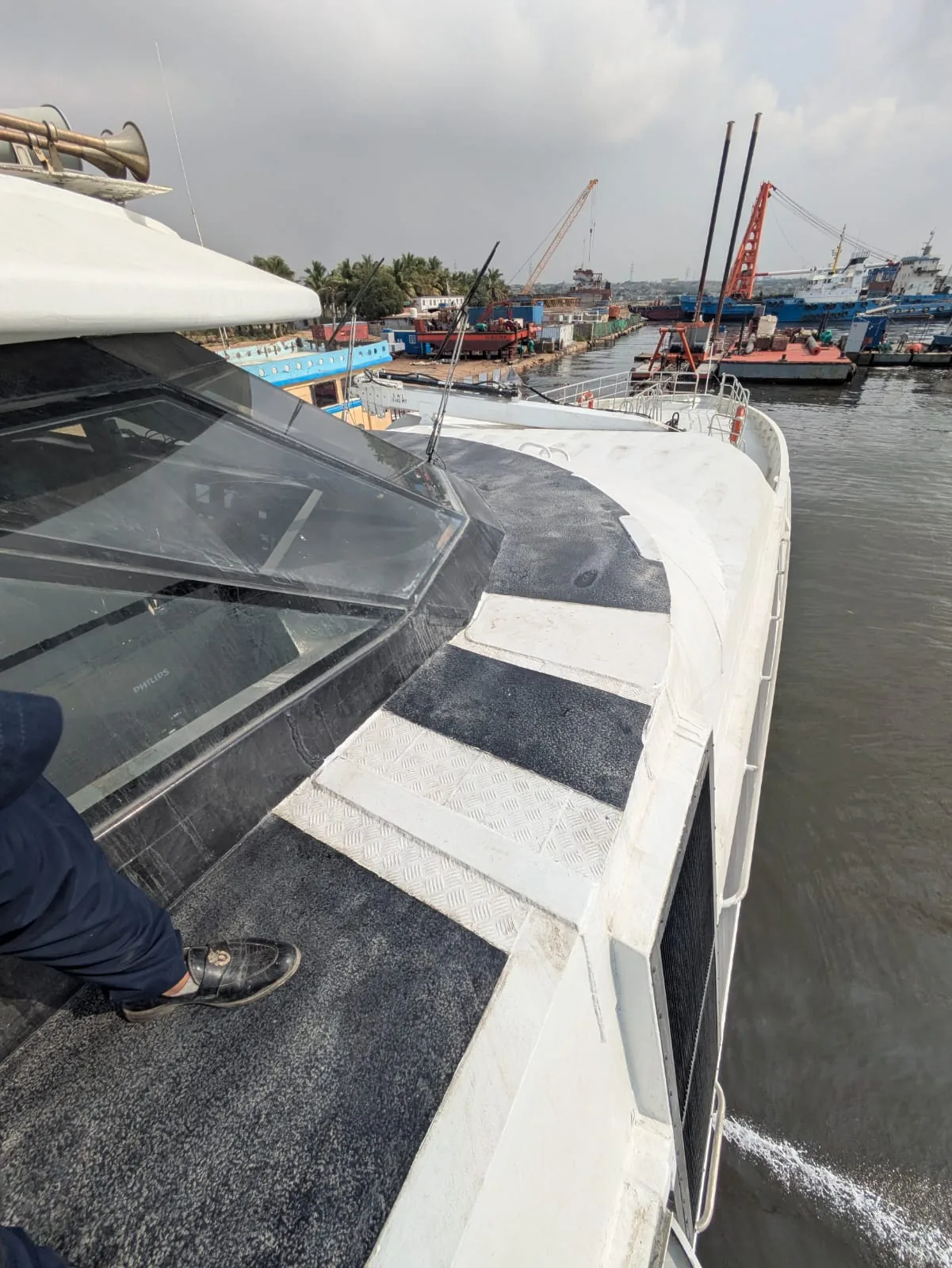
Walk along any busy ferry quay in Zanzibar, the Gulf, the Red Sea or South-East Asia and you will find aluminium monohull fast ferries of 30–40 m that have been in service for two or three decades. They keep earning because they combine speed, capacity and simplicity in a hull that can be maintained almost anywhere. Here is why operators keep choosing them and what to look for when buying one.
Monohull versus catamaran
Catamarans offer wide decks and low wash, but they need two engine rooms, two sets of shafts and a beam that many older berths and slipways cannot take. A monohull of the same length carries a similar passenger load with one engine room, simpler shaft lines and a narrower beam that fits conventional quays. For a 35 m vessel the monohull usually has the lower purchase price, lower maintenance bill and easier slipping — and its motion in a following sea on an open crossing is often more comfortable for passengers.
Why aluminium
Aluminium construction keeps the lightship weight low, which is the reason a 35 m ferry carrying more than 200 people can make 28 knots on a Caterpillar C32 installation. Aluminium does not rust, so a hull that has been kept clean and protected from galvanic contact with steel fittings will stay sound for decades. The trade-off is that aluminium needs careful attention to earthing, anodes and any dissimilar-metal joints, and repairs need a yard with aluminium welding capability — which today includes most yards serving fast-craft fleets.
The Australian-built generation
Through the 1980s and 1990s Western Australian builders such as Wavemaster produced a large number of aluminium monohull fast ferries for Hong Kong, Indonesia, the Philippines, the Pacific islands and the Middle East. They were designed for long open-water crossings in tropical conditions, with enclosed, air-conditioned saloons, raised wheelhouses and generous fuel capacity. Many of these vessels have been rebuilt and re-engined since, and a refitted example can offer a new operator ten or more years of service at a fraction of newbuild cost.
What to check on an older aluminium hull
A surveyor familiar with fast craft will look for plating thinning at the waterline and in the bilges, cracking at frame-to-plating welds and engine beds where vibration concentrates, corrosion around through-hull fittings and anywhere stainless or bronze fittings touch the aluminium, and the condition of the shafts, brackets, propellers and rudders. On the machinery side, ask for engine hours, service history and a sea trial at load. Check that the stability booklet reflects the current seat plan and that life raft capacity matches the passenger certificate you intend to obtain.
Refit potential
Because the structure is light and the saloons are open spaces, aluminium monohull ferries are easy to reconfigure. Seat plans can be changed for tourist, commuter or VIP layouts, a section of the upper deck can be opened for sightseeing, and the aft deck can be adapted for luggage, bicycles or light cargo. Crew-boat conversions add personnel seating and deck cargo space with minimal structural work. Sea Keepers' naval architects carry out this design and refit work in Karachi before delivery.
Sea Keepers has a Wavemaster-design 35 m aluminium monohull fast ferry for sale now — built 1995, rebuilt 2018–2019, 220 persons, 28.3 knots — lying Karachi with inspection and delivery support to the Gulf, East Africa, the Red Sea and South Asia.
View the full listing, specification and photo galleryWant the full specification pack or a delivery quotation?
Enquire about the ferry