
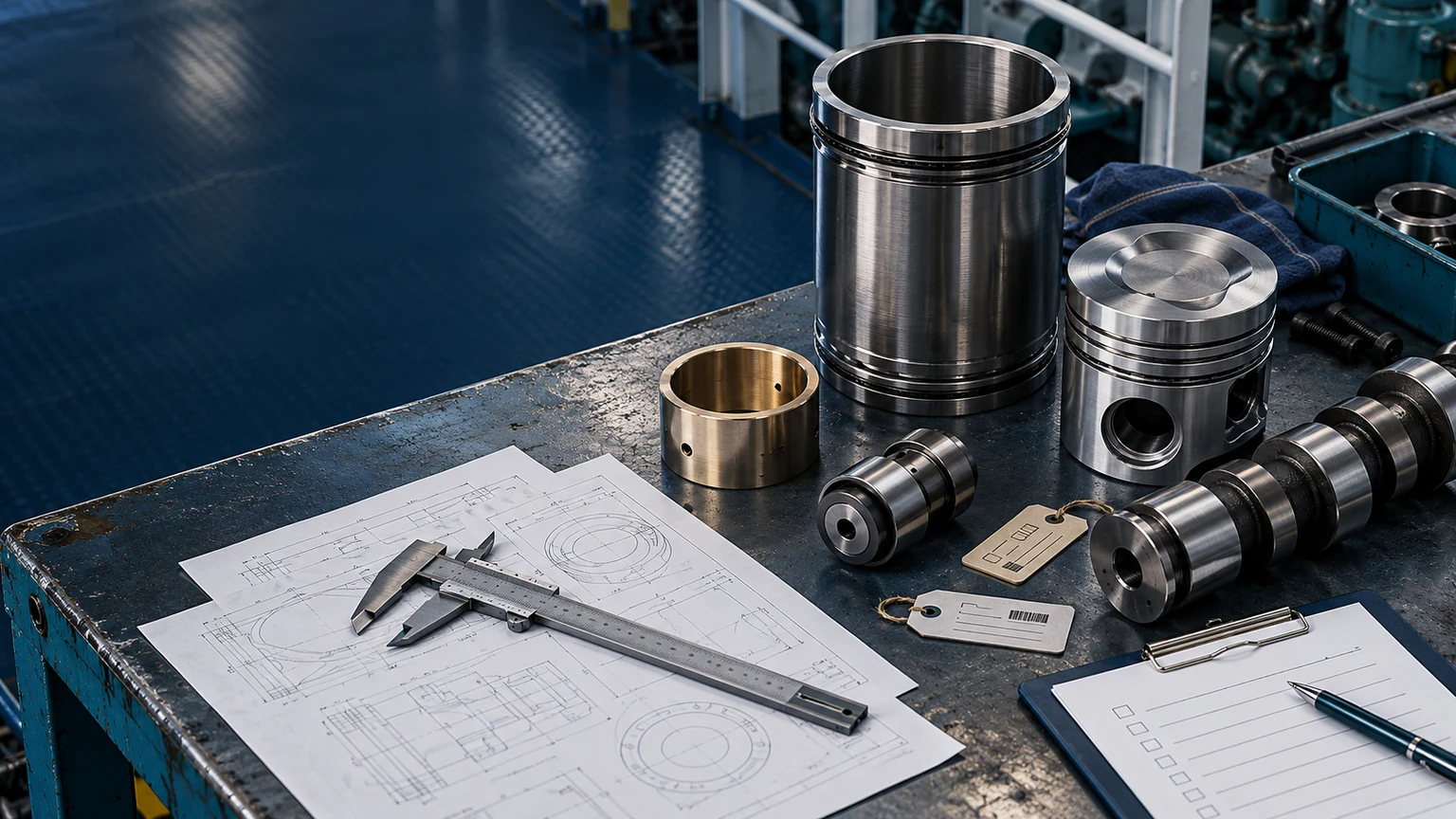
AI-generated editorial illustration.
A spare-parts enquiry can contain the correct component name and still produce the wrong item. Marine engines are built in arrangements, serial-number ranges and revision levels, while familiar descriptions such as liner, piston, bush or camshaft can cover several incompatible parts. A strong request for quotation therefore combines equipment identity, an exact reference, technical evidence and a clearly defined supply scope.
1. Identify the parent equipment first
Record the engine maker, model, serial number, arrangement or build number and vessel name before listing parts. Add a clear photograph of the nameplate and state whether the component belongs to the main engine, auxiliary engine, genset, outboard or gearcase. This establishes the configuration against which every part number must be checked and is more reliable than identifying a component from appearance alone.
2. Use the exact part number and manual revision
Copy the part number from the correct illustrated parts catalogue or maker drawing and attach the relevant exploded-view page. Preserve punctuation, suffixes and revision letters because they can distinguish material, size or application. If an old part carries a different marking, include both references and ask the supplier to confirm whether the newer number is a valid supersession rather than assuming the two are interchangeable.
3. Define the condition and replacement scope
State whether the requirement is new OEM, approved alternative, service-exchange or repair. Clarify whether a listing is a bare component, a matched assembly or a kit. For example, a piston request may also need rings, pin, clips and a matched liner; a camshaft job may require followers, bushes, seals and timing hardware. Asking the supplier to list inclusions and exclusions makes competing quotations comparable.
4. Add measurements without replacing traceability
Dimensions are valuable supporting evidence when recorded with a calibrated tool and an identified datum. Typical checks include liner bore and flange form, piston skirt diameter and compression height, bush inside and outside diameters, camshaft journal diameter and axial-ring thickness. Measurements should verify the documented reference, not be used to reverse-engineer a substitute when maker and serial information is available.
5. Describe the failure and inspect mating parts
Explain why the part is being replaced: scheduled overhaul, wear limit, scoring, seizure, pitting, loss of oil pressure or an unexpected failure. Include photographs of the removed part and its mating surface. This is especially important for camshafts, followers, bushes and piston assemblies because an unresolved lubrication, alignment or contamination problem can damage the replacement soon after installation.
6. State quality and documentation requirements
List any maker certificate, material certificate, inspection report, dimensional report, country-of-origin declaration or class-related documentation required by the vessel or owner. Define preservation and packing expectations for machined surfaces, moisture protection and long-term storage. These requirements must appear in the RFQ so that documentation and packing costs are included before the purchase order is placed.
7. Make logistics part of the technical request
Provide the required-on-board date, delivery port, preferred Incoterm and consignee details. If the vessel is moving, include the port-call window and a fallback location. Ask for stock status, dispatch lead time, packed dimensions and gross weight separately; a quoted manufacturing lead time is not the same as the date the goods will reach the vessel.
8. Compare quotations line by line
A useful comparison checks manufacturer, exact part reference, supersession evidence, quantity, unit of supply, condition, inclusions, certificates, warranty, lead time, packing and freight basis. Treat phrases such as suitable for or equivalent as requests for technical substantiation. Any deviation should be identified and approved before ordering rather than discovered during installation.
Using the Sea Keepers approved-product records
Sea Keepers assigns each published item a traceable catalogue code and a dedicated specification page. Those pages create a consistent starting point for an enquiry, while final compatibility is confirmed against the equipment identity and evidence supplied by the buyer. The linked examples below show how liners, piston bodies, crankcase breathers, connecting-rod bushes and camshaft components are separated into individual approved records.
For the business buyer
Confirm the intended vessel or facility, operating environment, quantity and required approval before requesting a quotation. Capacity, coverage and service interval should be matched to the risk rather than selected by headline price.
For technical experts
Verify the delivered model against the maker reference, rating, dimensions, materials, operating limits and certification scope. Record the serial or batch number and retain the manufacturer datasheet, declaration, test report and maintenance instructions in the vessel file.
Product comparison
Compare alternatives on certified performance, compatibility, installation requirements, inspection interval, spares availability and total life-cycle cost. A lower unit price is not a like-for-like comparison when approval documents or service support differ.
Send a complete spare-parts RFQWant the full specification pack or a delivery quotation?
Enquire about the ferry